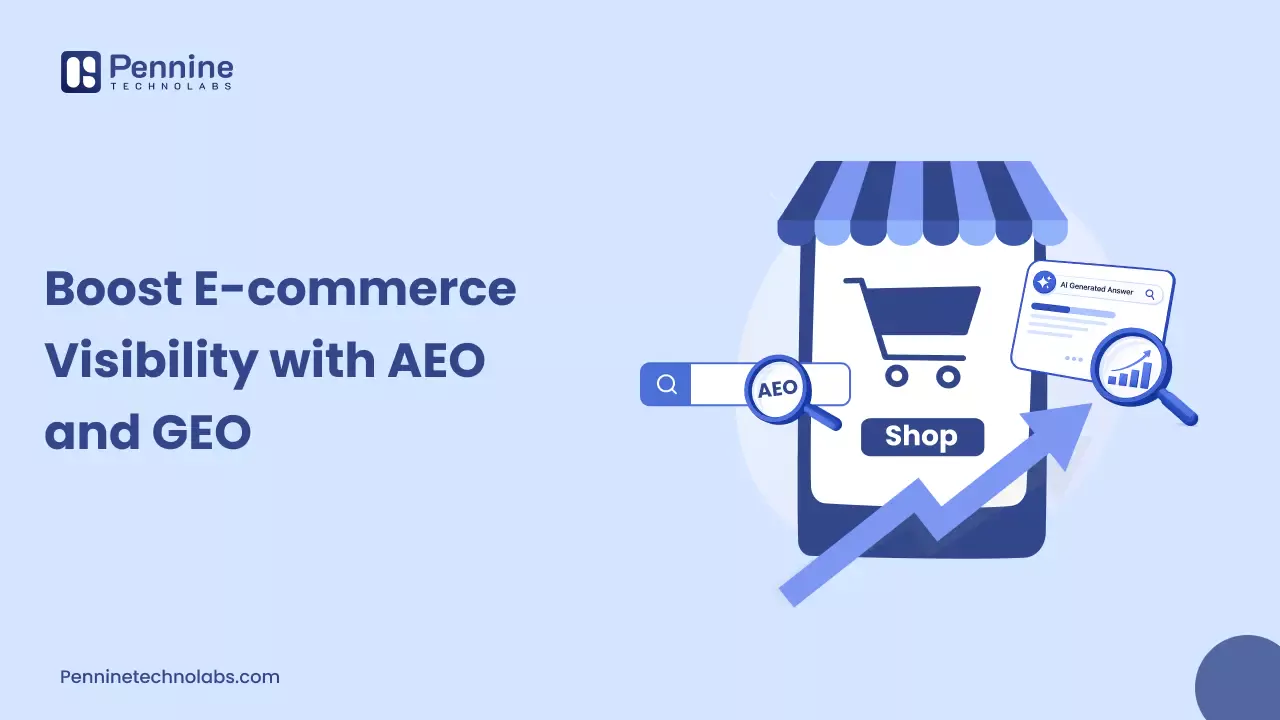
Quick Summary: Your online store might rank on Google, but it’s invisible where customers actually search now. AI-powered search engines have changed how people discover products. Here’s what you need to know:
– AEO (Answer Engine Optimization) helps your content appear in AI-generated answers across ChatGPT, Google AI Overviews, and Gemini
– GEO (Generative Engine Optimization) makes your products discoverable through contextual, AI-driven search results
– Traditional SEO alone no longer captures the full customer journey
– AI search influences 40+ percent of online discovery today
– E-commerce brands need both strategies to stay competitive and visible
Introduction
Your best-selling product ranks on page one of Google. Your competitors’ similar products appear in ChatGPT recommendations. Your store gets overlooked.
This is the new reality for e-commerce businesses that rely only on traditional search optimization. While Google remains important, customers increasingly turn to AI chatbots, voice assistants, and generative search platforms to discover products. These systems pull answers from different sources using different ranking signals than Google uses.
Without optimizing for these new search engines, your e-commerce store is missing potential customers at the exact moment they’re ready to buy.
The good news: You can fix this. The better news: Most of your competitors haven’t started yet.
Why Traditional SEO Alone Is No Longer Enough for E-commerce
Search behavior has fundamentally shifted. Five years ago, the customer journey looked like this: search Google, click link, visit website, buy product. Today’s customer journey is messier and more distributed.
A shopper researches a product category in Perplexity. Another asks ChatGPT for product recommendations. A third uses voice search while driving. A fourth browses Bing Copilot for comparisons. Each platform uses different algorithms, different sources, and different ranking factors.
Google prioritizes backlinks, page authority, and user experience signals. Answer engines prioritize direct answers, expert content, and relevance to specific questions. This means the website that ranks first in Google might not appear in ChatGPT or Google AI Overviews at all.
Traditional SEO was built for links and clicks. Modern search optimization needs to work across multiple platforms with different mechanics. For e-commerce, this gap is expensive. Every customer who gets an answer from an AI system without discovering your product is a lost sale.
What Is AEO and Why Does It Matter for Online Stores?
Answer Engine Optimization (AEO) is the practice of structuring your content so that AI systems can easily find it, understand it, and serve it as an answer to customer questions.
AEO for e-commerce means optimizing your product pages, FAQs, and content so that ChatGPT, Google AI Overviews, Gemini, and other answer engines pull your information when customers search for solutions you provide.
Here’s how answer engines work: A customer types a question like ‘best lightweight running shoes for flat feet.’ The AI system searches the web, identifies relevant sources, extracts information from multiple pages, and synthesizes an answer. If your product pages are well-structured and comprehensive, your products get included in that answer.
Compare two product pages. Page A has a generic description: ‘High-quality running shoes.’ Page B has detailed information: ‘Designed for flat feet, 12-degree arch support, 8.2-ounce weight, tested on 200+ miles of pavement.’ Page B gets pulled into AI answers because it provides specific, extractable information.
Featured snippets and voice search results also rely on AEO principles. When your content answers a specific question in a clear, concise way, Google is more likely to feature it, and voice assistants are more likely to read it aloud.
Understanding GEO in Modern Retail Search
Generative Engine Optimization (GEO) focuses on how AI systems understand and recommend products based on context, entity relationships, and semantic meaning rather than just keyword matching.
GEO ecommerce strategies work because generative search engines don’t just match keywords. They understand relationships. If a customer asks for ‘cozy fall sweaters,’ a GEO-optimized site helps the AI understand your products through entity relationships (brand, material, style, season, customer segment) and contextual signals.
This is different from traditional keyword optimization. With old SEO, you’d target the exact phrase ‘cozy fall sweaters.’ With GEO, you optimize for the concept of coziness, seasonal relevance, material properties, and customer intent across your entire product catalog.
Generative Engine Optimization for retail means your product knowledge graph signals are strong. Your brand is recognized as an authority in your category. Your reviews contain rich semantic information. Your product descriptions explain what problems they solve, not just features.
When a customer uses Perplexity or Bing Copilot, these systems generate contextual answers that recommend products matching the user’s specific needs. If your GEO strategy is solid, your products are recommended naturally within those answers.
How AI Search Engines Influence Customer Buying Decisions
AI doesn’t just change where customers search. It fundamentally changes how they make decisions.
AI-generated product comparisons have become trusted decision-making tools. A customer asks ChatGPT, ‘Compare budget laptops with long battery life.’ The AI compares options side-by-side with pros and cons. This recommendation often drives purchase decisions faster than browsing reviews on 10 different websites.
Product recommendations from AI systems carry implicit endorsement. When Gemini recommends your product in response to a specific query, it feels like expert advice, not advertising. This influences trust and purchase intent more than traditional ads.
Purchase journeys are also compressed. Instead of visiting three websites, reading reviews, and comparing specs, customers get a curated answer in seconds. Whoever appears in that AI-generated answer wins the customer.
Voice search adds another layer. A customer drives home and asks Alexa, ‘What’s the best affordable desk lamp?’ If your product appears in that voice result, it gets considered. If it doesn’t, it’s eliminated from the decision.
Review analysis by AI systems has become critical. When an AI system evaluates a product category, it doesn’t just count reviews. It reads them for sentiment, specific benefits mentioned, common complaints, and verification signals. Authentic customer feedback directly influences whether your product gets recommended.
Important AEO Tactics for E-commerce Websites
Implementing AEO requires specific content structures that answer engines can process.
Structured Data is Non-Negotiable.
Use Schema.org markup for products, including name, description, price, availability, reviews, and ratings. This tells AI systems exactly what information they’re looking at and how to use it.
Conversational Content Works Better Than Marketing Copy.
Write product descriptions that explain benefits and answer concerns naturally. Instead of ‘Premium Performance Features,’ write ‘You’ll notice the difference within the first week of use because the reinforced sole handles your stride differently.’
Question-Based Headings Make Content Scannable for AI and Humans.
Use actual customer questions as subheadings: ‘What Makes This Different from Generic Alternatives?’ instead of ‘Product Features.’
Voice Search Optimization Means Using Natural Language.
People ask voice assistants in conversational phrases. Your content should answer those natural queries, not just keyword phrases.
GEO Strategies That Help Products Appear in AI Answers
Beyond AEO, generative search requires entity-level optimization. Here are the key strategies for GEO ecommerce success.
Entity Optimization means your brand, products, and category are clearly identified and well-defined. Create a strong company knowledge graph. Make sure your brand name, category, and key attributes are consistently mentioned in content.
Product Knowledge Graph Signals help AI understand your products better. Connect your products to their categories, materials, brands, customer segments, and use cases through intentional content linking and structured data.
Review Content should contain rich semantic information. Don’t just collect star ratings. Encourage specific, detailed reviews that mention particular benefits and use cases. AI systems extract this information to understand whether your product matches user needs.
Category Page Optimization provides context that generative engines use when recommending products. A category page isn’t just a list. It’s an opportunity to explain the category, describe different types of customers, explain decision factors, and show how products differ.
Expert Content strengthens your authority. If you’re a retailer, publish guides, how-tos, and educational content that establishes expertise. AI systems prioritize information from sources that demonstrate category knowledge.
Brand Authority is critical. Mention your brand name naturally across content. Get mentions from other relevant websites. Build your brand as a recognized entity in your category.
Building Product Pages That AI Can Easily Understand
Product page structure matters more than ever. Here’s what AI systems look for.
Product descriptions should be 300+ words and explain what the product is, who it’s for, what problems it solves, and why it’s better than alternatives. Don’t just list specs.
Specifications should be detailed and scannable. Use lists and tables so AI can extract information easily. Include dimensions, weight, materials, colors, compatibility, and relevant technical details.
FAQs should cover common concerns: sizing, shipping, returns, warranty, care instructions, and comparisons to similar products. Answer questions directly without marketing language.
Reviews signal trustworthiness. Include customer reviews with verified purchase badges and specific feedback. AI systems weigh authentic customer opinions heavily.
User-Generated Content like photos and videos from real customers influence AI recommendations. This content is harder for competitors to replicate and builds trust signals.
Structured Data tells AI what everything means. Use Product Schema, Offer Schema, Review Schema, and Organization Schema across your pages.
Common Mistakes That Hurt AI Visibility
Several common mistakes prevent e-commerce sites from appearing in AI-generated answers.
Thin Content is the biggest problem. Product pages with 50 words of generic description won’t be recommended by AI systems. They need substance.
Duplicate Product Descriptions across multiple similar products confuse AI about product differences. Customize descriptions for each variant.
Missing Schema means AI systems have to guess what your information means. Add structured data.
Weak Authority Signals hurt rankings in answer engines. If your site isn’t recognized as an authority in your category, AI systems won’t prioritize your products.
Poor Content Structure makes extraction difficult. Use clear headings, short paragraphs, lists, and tables so AI can parse your content easily.
The Role of a Modern Digital Marketing Agency
Optimizing for both traditional search and AI search is complex. That’s why many e-commerce brands work with specialists.
A modern Digital Marketing Agency doesn’t just handle SEO anymore. It manages:
- Traditional SEO for Google visibility
- AEO strategy for answer engines
- GEO tactics for generative search
- Content structure for AI extraction
- Technical optimization across platforms
- Authority building and brand recognition
The best agencies understand how these strategies work together. E-commerce SEO Services requires different expertise than traditional optimization, and companies like Pennine Technolabs integrate both into a unified strategy.
Why Many Retail Brands Partner with an SEO Agency in the USA
The US e-commerce market is hypercompetitive. Brands compete against established players, new startups, and international retailers simultaneously.
An SEO Agency in the USA with modern expertise helps retail brands:
- Compete in multiple search environments at once
- Scale visibility across Google, AI platforms, and voice search
- Build authority faster than organic growth allows
- Navigate rapidly changing search algorithms
- Optimize globally while maintaining local relevance
Digital Marketing Solutions that work across traditional and AI search require specialized knowledge and ongoing optimization. Brands in competitive niches can’t afford to miss sales because they’re invisible in ChatGPT or Gemini.
Comparison Table: Traditional SEO vs AEO vs GEO
| Factor | Traditional SEO | AEO | GEO |
|---|---|---|---|
| Primary Platform | Google Search | ChatGPT, Gemini, Claude | Perplexity, Bing Copilot |
| Ranking Signals | Backlinks, page authority, relevance | Content structure, Q&A, specificity | Entity relationships, semantic meaning |
| Content Format | Blog posts, guides, product pages | FAQ, definitions, concise answers | Category content, knowledge bases |
| Optimization Focus | Keywords and links | Direct answers and clarity | Context and relationships |
| Customer Intent | Search and research | Get answers quickly | Understand context and options |
| Best For | Initial discovery | Decision support | Personalized recommendations |
Ready to Optimize Your E-commerce Store for AI Search?
AEO and GEO aren’t one-time fixes. They require ongoing optimization as search engines evolve and customer behavior shifts. Most e-commerce brands struggle with implementation because they lack expertise in both traditional and AI-powered search strategies.
That’s where Pennine Technolabs comes in. Our team specializes in building comprehensive SEO and AI search strategies for e-commerce brands across the USA, UK, Australia, and India. We don’t just optimize for Google anymore. We optimize for ChatGPT, Gemini, Perplexity, voice search, and every platform where your customers discover products.
If your e-commerce store is invisible in AI-powered search platforms, or if you’re competing against brands with better visibility, reach out. We’ll audit your current visibility across multiple search engines and build a strategy that captures customers where they actually search. Your competitors are moving fast. Don’t get left behind.