Quick Summary: A multi-tenant SaaS app serves many customers from one codebase, with each customer’s data kept separate. Laravel handles authentication, queues, and APIs with little extra setup. React builds fast, reusable dashboards that update without page reloads. This stack fits startups and enterprises that need to scale without rebuilding. Best suited for founders planning to onboard hundreds or thousands of tenants over time.
A founder once told us his SaaS product worked fine for ten customers. At five hundred, the database choked, tickets piled up, and every new client meant a custom deployment. That is what happens when a product is built without a tenant strategy from day one.
Multi-tenancy decides how fast you can onboard customers, how safe their data stays, and how much it costs to scale. Laravel and React, used together, give you a backend that handles business logic cleanly and a frontend that feels fast no matter how many tenants share the system.
This guide covers how the architecture works, the database choices you will face, and the mistakes that slow teams down.
What is a Multi-Tenant SaaS Application?
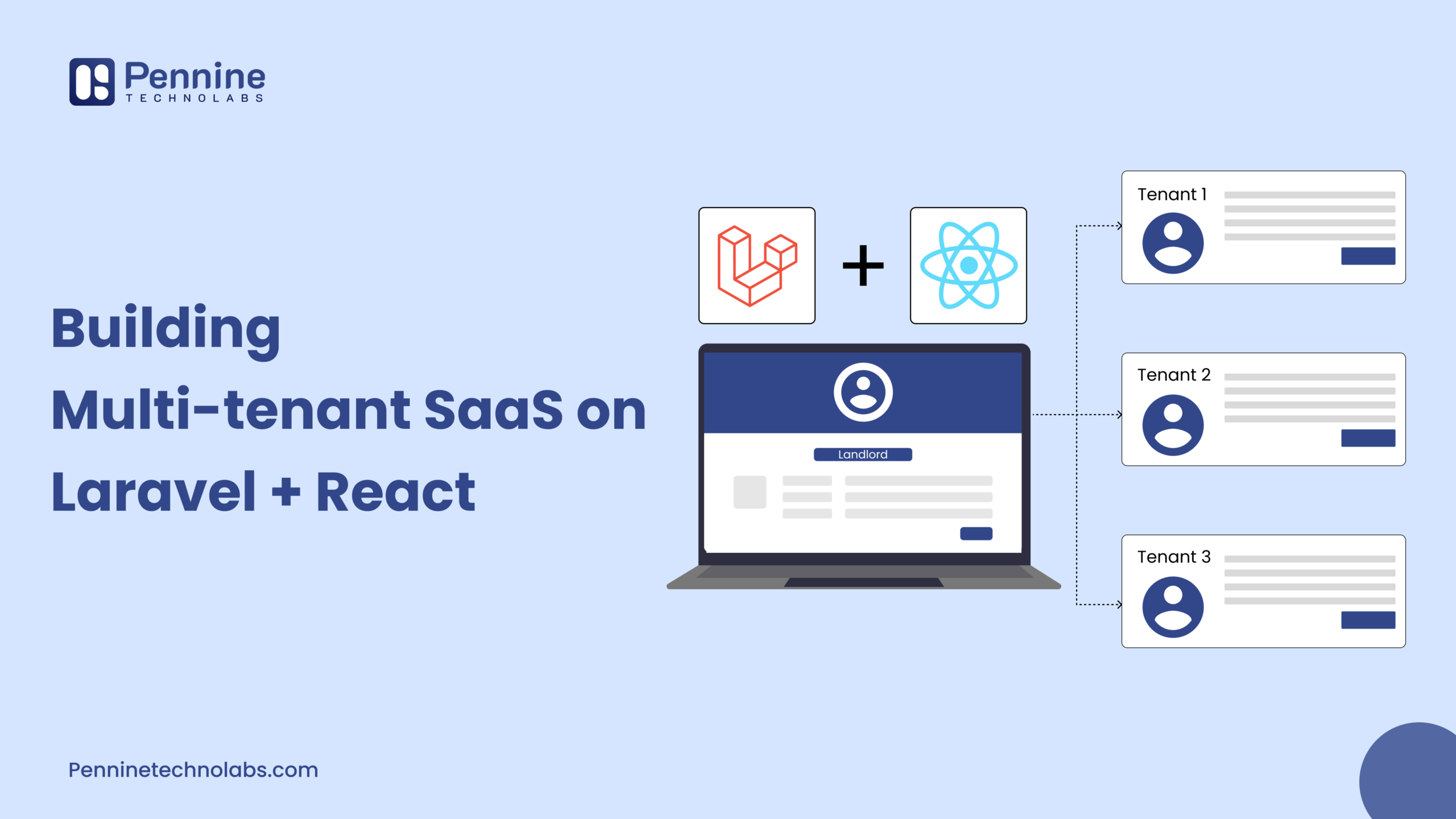
A multi-tenant SaaS application serves multiple customers, called tenants, from a single instance of the software. Each tenant gets their own data and settings, but they run on the same codebase and infrastructure.
Just like in an apartment building, every tenant has a private unit but shares the same plumbing and foundation. Slack, HubSpot, and Shopify work this way. One update ships to every customer at once, but no user sees another user’s data.
| Multi-Tenant | Single-Tenant |
|---|---|
| One codebase serves all customers | Each customer has a separate codebase or instance |
| Lower hosting cost per customer | Higher hosting cost per customer |
| Faster updates across all users | Updates must be applied individually |
| Requires strong data isolation | Data isolation is automatic by design |
| Easier to scale to thousands of users | Harder to scale past a few hundred clients |
Why Laravel Is a Strong Backend Choice for Multi-Tenant SaaS
Laravel gives you the building blocks a multi-tenant product needs without writing them from scratch.
Authentication. Sanctum and Passport handle login, tokens, and sessions for web and mobile clients.
Security. Built-in protection against SQL injection, CSRF, and XSS reduces the attack surface. Middleware enforces tenant-level access rules on every request.
Queues. Background jobs, like invoices or uploads, run through Redis without blocking the user.
APIs. Laravel’s routing and resource controllers make it fast to build clean REST or GraphQL APIs for a React frontend.
Database management. Eloquent ORM and migrations keep schema changes version-controlled, even across hundreds of tenant databases.
Scalability. Laravel works well with horizontal scaling, load balancers, and caching layers like Redis as traffic grows.
You don’t have to build tenant isolation manually, either. Packages like stancl/tenancy and Spatie’s multitenancy package handle database switching, tenant-aware caching, and per-tenant configuration out of the box. They save weeks of work, though most teams still end up customizing how tenants are identified and provisioned.
Teams that work with experienced Laravel Development Services partners avoid the early architecture mistakes that are expensive to fix later.
Why React Works Well for SaaS Frontends
A SaaS dashboard needs to feel instant. Users switch between reports, settings, and tables all day. React handles that interface well.
- Dynamic UI: React updates only the parts of the screen that change, keeping dashboards responsive with live data.
- Reusable components: Build a table, chart, or form once and reuse it across every tenant view.
- Faster user experience: Combined with a Laravel API, React apps load data asynchronously instead of reloading full pages.
- Dashboard development: Charting libraries and component frameworks plug directly into React, speeding up admin panel builds.
- State management: Tools like Redux or React Query keep tenant data organized and prevent one customer’s session from leaking into another’s view.
Many companies pair their backend work with React Development Services to make sure the frontend architecture matches the API design. Many SaaS teams also hire React Developer in USA talent for this stage, since dashboard UX often decides whether tenants stick around.
Core Architecture of a Laravel + React Multi-Tenant SaaS Platform
A typical setup looks like this:

Authentication layer: Sanctum issues tokens tied to a tenant ID.
Tenant resolution: Before isolation even matters, Laravel has to know which tenant is making the request. The three common patterns are subdomains (acme.yourapp.com), a custom domain mapped to a tenant record, or a path/header-based identifier (/t/acme/… or an X-Tenant header) for API-only products. Subdomains feel the most “SaaS-native” to users, but custom domains are usually what enterprise buyers expect.
Tenant isolation: Middleware checks the tenant ID on every API request.
API layer: Laravel exposes REST endpoints that React consumes through Axios or Fetch.
Database strategy. Tenant data is separated using one of the methods below.
Frontend architecture: React handles routing, state, and UI rendering, calling the API for every data operation.
Role management: Permissions are scoped per tenant, so an admin in one company cannot see settings in another.
This flow keeps the backend as the source of truth while React stays focused on presentation. A Full Stack Developer who moves comfortably between both layers keeps this consistent as the product grows.
Database Strategies for Multi-Tenant SaaS
There are three common ways to structure tenant data in Laravel.
- Shared database, shared schema. All tenants use the same tables, separated by a tenant_id column.
- Shared database, separate schema. All tenants share one database server, but each gets its own schema.
- Separate database per tenant. Each tenant gets a fully isolated database.
| Strategy | Pros | Cons |
|---|---|---|
| Shared database, shared schema | Cheapest, easiest to maintain | Higher risk of data leaks if queries are wrong |
| Shared database, separate schema | Good balance of isolation and cost | More complex migrations |
| Separate database per tenant | Strongest isolation, easiest compliance | Higher hosting cost, harder to scale past thousands of tenants |
Most startups begin with shared schema. Enterprise clients with compliance needs often require separate databases.
If you’re selling into regions with data residency rules, like the EU or healthcare and finance clients almost anywhere, the database strategy gets tangled up with geography too. A tenant in Germany may legally need its data stored on EU infrastructure, which usually pushes you toward separate databases (or at least separate read replicas) per region rather than a single shared cluster.
Common Challenges and How to Solve Them
Security: Filter every query by tenant ID. Global scopes enforce this automatically.
Data isolation: Write automated tests that confirm one tenant cannot access another’s data.
Performance: Index the tenant_id column on every table, or queries slow down as tenant count grows.
Scaling: Use read replicas and caching for high-traffic tenants instead of scaling the whole database.
Billing: Integrate usage-based billing through Stripe, tied to tenant-level metering.
User permissions: Build role-based access control scoped to each tenant.
When Should You Choose Laravel + React for Your SaaS Product?
This stack makes sense if:
- You expect to onboard many customers with similar core features
- You need a dashboard-heavy product with real-time updates
- Your team needs fast development cycles without sacrificing security
- You plan to scale from dozens to thousands of users
- You want backend and frontend maintained by separate specialized teams
It is less ideal for simple landing pages or apps with no recurring data interaction.
Team Pennine Technolabs is Only A Call Away
Architecture decisions made in month one affect your product for years. A team that gets tenant isolation wrong often has to rebuild the database layer later, which is costly with live data.
This is why many SaaS companies bring in a Full Stack Developer who understands both the Laravel backend and React frontend, rather than splitting work across teams that do not talk to each other.
Pennine Technolabs pairs Laravel Development Services with React Development Services under one roof, so both sides of your stack are built to work together. So, just don’t give it a second thought and schedule your 1:1 discussion with our professionals.