Quick Summary: Choosing the right web development stack can shape the future of your SaaS product. This guide explains the most reliable tech stacks used by successful startups today and helps you pick the one that supports fast growth, strong performance, and long term scalability for your business.
For SaaS founders, choosing a web development stack is not just a technical decision; it is a financial and operational baseline. The right stack controls your runway, your developer hiring costs, and your ability to scale from a Minimum Viable Product (MVP) to a complex enterprise application. In 2026, the modern stack has shifted from simple backend/frontend divides to integrated, AI-augmented, and edge-native ecosystems.
Building a web application for SaaS company is very competitive. Your time is ticking, and you’re burning cash while competing to attract users. Your web tech stacks in this environment is not code. It is what your business logic is based on. Select the appropriate tech stack for Startup, and you climb with ease. Make the wrong one, and you will spend your Series A funding refactoring technical debt as opposed to growing.
If you are a Non-technical founder or CTO seeking the edge in 2026, look beyond the hype. You require stability, speed, and a cost-effective talent pool.
Best for Fast MVPs: Ruby on Rails or MEVN
Best for Enterprise Scaling: MEAN (Angular)
Best for AI & Data: Python with Django
Best for Bootstrapped Startups: LAMP (Laravel)
We are going to discuss the optimal web development stacks in SaaS startups that work in practice.
What is a Web Development Stack?
A web development stack is the set of technologies used to build the front-end and back-end of a web application. It is the entire toolkit that drives a SaaS product from the first line of code to its behavior in production.
A typical web stack includes:
Frontend Technologies
This controls everything the user sees and interacts with. Buttons, dashboards, onboarding screens, tables, notifications, and user flows. Frameworks such as React, Angular, and Vue are popular options for creating fast, responsive interfaces.
Backend Technologies
And this is the logic behind your product. It handles authentication, permissions, billing, automation, processing, and communication between the database and the frontend. Standard backend options include Node.js, Laravel, Django, Spring Boot, and Rails.
Database
Every SaaS company relies on data. Users, subscriptions, analytics, product inputs, or uploaded files they all stored in the database in a friendly and easy-to-access format. Popular ones, based on structure and scale, include PostgreSQL, MongoDB, MySQL, and Firebase.
DevOps and Infrastructure
This ensures the app operates smoothly and scales without downtime. Cloud providers such as AWS, Google Cloud, and DigitalOcean, and services such as Docker and Kubernetes, are used to automate code deployment, increase reliability, and scale.
For SaaS founders, the right stack can save months of rework and dollars in the development process.
What are the top Web Stack Technologies in 2026?
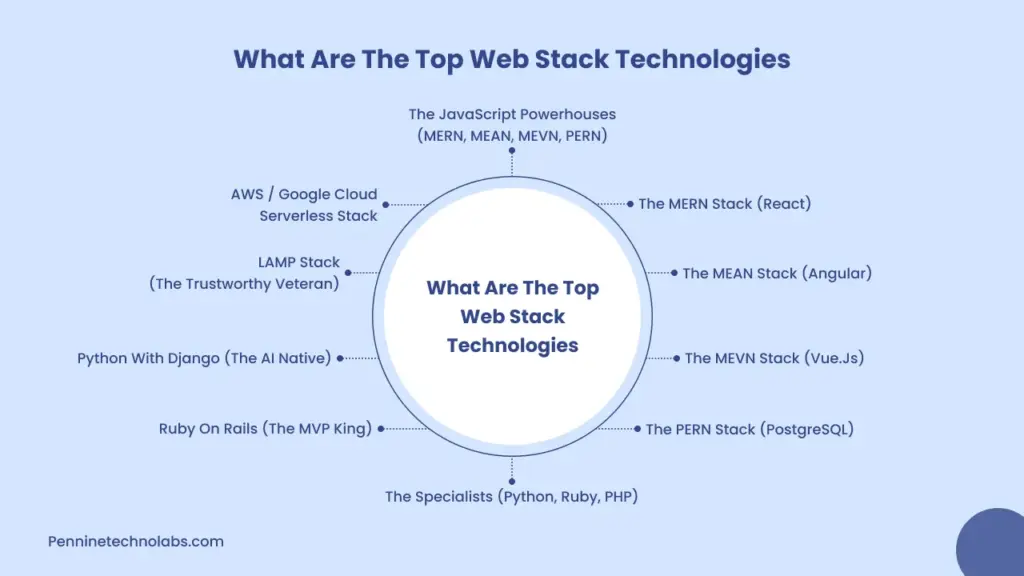
The most popular web stack technologies in 2026 have a perfect balance of performance, scalability, and ecosystem. JavaScript stacks such as MERN and MEAN are still the most popular to date because they allow a team to develop and iterate faster with a single language throughout the application.
Next.js, whether with Node or a server less provider, has become a practical option for SaaS startups that require performance, SEO readiness, and scalability in the Cloud.
Python and Django, or FastAPI, have become highly popular in machine learning-friendly, data-intensive applications that require security and proven stability, mainly as AI-powered applications.
The combination of Laravel and MySQL/PostgreSQL remains a solid choice for subscription-based SaaS applications, thanks to its built-in authentication, clean architecture, and rapid development cycle.
Overall, tech stacks that integrate with cloud platforms, support microservices, and minimize development overhead are the future of SaaS builds.
| Business Objective | Recommended Tech Stack | Core Front-End / Back-End | Why It Wins for Startups |
| Fastest MVP Launch (Under 30 Days) | Ruby on Rails / Laravel | Blade / React (via Inertia.js) + PostgreSQL | Batteries-included authentication, routing, and built-in database ORMs to eliminate boilerplate. |
| High-Performance Scaling & API-Heavy | MERN / PERN Stack | ReactJS + Node.js/Express + MongoDB/Postgres | Rich talent pool, seamless JSON handling, and asynchronous API performance. |
| AI-Native & Machine Learning SaaS | Python + React Stack | ReactJS + Django (Python) + PostgreSQL | Seamless integration with LangChain, LlamaIndex, and major MLOps pipelines. |
| Serverless & Ultra-Low DevOps Overhead | Next.js Serverless Edge | Next.js (React 19) + Vercel + Supabase | Zero-latency global delivery via edge runtimes; slashes server infrastructure costs. |
The JavaScript Powerhouses (MERN, MEAN, MEVN, PERN)
JavaScript is the leading language of modern web development for a reason. It allows a single language on both the front end and the back end. This brings your team together and accelerates growth.
| Stack | Frontend | Backend | Database | Best For |
|---|---|---|---|---|
| MERN | React | Node.js | MongoDB | Modern web applications |
| MEAN | Angular | Node.js | MongoDB | Enterprise applications |
| MEVN | Vue | Node.js | MongoDB | Flexible web applications |
| PERN | React | Node.js | PostgreSQL | Data intensive applications |
| LAMP | HTML/CSS/JS | PHP | MySQL | Traditional websites |
| Laravel | Blade/React/Vue | Laravel | MySQL/PostgreSQL | Business applications |
| Django | React/Vue | Django | PostgreSQL | Data driven applications |
| Ruby on Rails | HTML/JS/React | Rails | PostgreSQL | Startups and MVPs |
| Next.js | React | Next.js | PostgreSQL etc. | SaaS and modern web apps |
The MERN Stack (React)
Components: MongoDB, Express.js, React, and Node.js.
Mern is currently the best tech stack for startup. React is supported by Meta and is characterized by the biggest ecosystem of pre-built components. And whether you need a dashboard, payment integration, or a drag-and-drop interface, someone has already written a React library to do it.
Best for: Fast-paced Applications, Single-Page Applications (SPA), and when the team prefers a single language.
Also Read: Need to build a scalable React Web application? Hire Dedicated ReactJS Developers
The MEAN Stack (Angular)
Components: MongoDB, Express.js, Angular, Node.js.
MERN is based on React, whereas MEAN is based on Angular. Angular is an opinionated, structured framework backed by Google. React offers freedom (which can lead to messy code unless you manage it well), whereas Angular provides a rigid framework. This makes it well-suited for enterprise-level SaaS, where it is critical to ensure a large team upholds coding standards.
Best for: Enterprise SaaS, Complex Fintech Systems, and Multimedia teams that have strict architecture.
The MEVN Stack (Vue.js)
Components: MongoDB, Express.js, Vue.js, Node.js.
Vue.js is the frontend framework supported by the community. It is lighter than React and is easier to master than Angular. MEVN stack is on the rise in 2026 due to its fast prototyping. MEVN is often the shortest path to market, enabling a lightweight MVP to test a market hypothesis.
Best for: Fast prototyping, light-weight, and founders who desire a smooth learning curve.
The PERN Stack (PostgreSQL)
Components: PostgreSQL, Express.js, React, Node.js.
It is the more disciplined sibling of the MERN stack. It replaces MongoDB (NoSQL database) with PostgreSQL (SQL relational database). When using the SaaS applications, which process the complicated financial data, the relationships with the users are strong, or when dealing with the inventory, the rigorous data integrity that SQL offers. PostgreSQL is the most sophisticated open-source database in the world, and a combination of it and React will provide you with the best of both worlds: a versatile interface and a data layer that will never break down.
Best Use: SaaS with Complex data relationships, Fintech, and Data-Critical Applications.
Other Popular Web Development Stacks (Python, Ruby, PHP)
In other cases, raw speed or particular capabilities can be more important than a full JavaScript stack.
Ruby on Rails Stack
Components: Ruby, Rails Framework, SQLite/PostgreSQL.
It is still used by unicorns such as Shopify, Airbnb, and GitHub, even though people claim that Rails is dead. Why? Due to its philosophy of Convention over Configuration. Rails makes many decisions on your behalf, so you write less code. It is the quickest way to create an effective MVP. Rails will remain the choice for founders who prioritize speed to market.
Best: Solo founders, fast MVPs, and validation stages.
Python and Django Stack
Components: Python, Django, PostgreSQL.
Python is a must-have if your SaaS is based on Artificial Intelligence or Machine Learning, or if it requires heavy data processing. AI is based on the native language. Django follows a batteries-included philosophy, i.e., it includes authentication, sitemaps, and administration panels. There is no need to re-invent the wheel.
Best for: AI-driven SaaS, Data Analytics platforms, and Machine Learning tools.
LAMP Stack
Components: Linux, Apache, MySQL, and PHP.
PHP powers nearly 80% of the web. The current version of PHP (Laravel framework in particular) is relatively quick, stylish, and highly reliable. It is inexpensive to host and simple to install. A senior PHP developer can be much cheaper than a niche Rust or Go developer is. This path is typically recommended by agencies such as Pennine Technolabs to founders interested in a strong, cost-effective, and scalable architecture.
Best fits: Bootstrapped founders, content management systems, and subscription-based tools.
AWS / Google Cloud Serverless Stack.
Components: AWS Lambda / Google Cloud Functions, DynamoDB / Firestore, React / Vue.
This is the paradigm shift. You do not manage servers; you just write single functions that are called whenever an event occurs (e.g., a user clicking buy). You only pay when your code is run.
This is a financial savior for a startup with unpredictable traffic. You are not paying lazy waiters at 3 AM. It, however, needs a different architectural thinking. You become highly reliant on your cloud provider (AWS or Google), though the trade-off is the loss of server control and the inability to scale beyond a certain point.
Best for: Event-driven applications, micro-SaaS tools, and applications with extremely high traffic.
Best Web Development Stack for Different Projects
There is no single technology stack that works best for every web application. The right choice depends on the type of product you are building, how complex it is, how quickly you need to launch, and how much you expect it to grow.
A stack that works well for an MVP may not be the same one you choose for a large enterprise application. Instead of choosing a technology because it is popular, it is better to match the stack with the project’s actual requirements.
1) Best Stack for SaaS Applications
SaaS applications usually need a stack that can support user authentication, APIs, subscriptions, dashboards, third party integrations, and future scalability.
Recommended options: Next.js with Node.js and PostgreSQL, MERN, or Laravel with React.
For an early stage SaaS product, the priority is usually development speed and flexibility. As the product grows, scalability, security, database performance, and maintainability become more important.
2) Best Stack for Startups and MVPs
Startups often need to validate an idea quickly without spending too much time building infrastructure.
Recommended options: Ruby on Rails, Laravel, Django, or a JavaScript based stack such as Next.js and Node.js.
A framework with built in functionality can help teams launch an MVP faster. Once the product gains traction, the architecture can be optimized around actual usage rather than assumptions made at the beginning.
3) Best Stack for Ecommerce
Ecommerce applications need to handle product catalogs, payments, customer accounts, orders, inventory, search, and integrations with other business systems.
Recommended options: Shopify or WooCommerce for faster launches, or a custom stack such as Laravel, React, and PostgreSQL for more complex requirements.
The right choice depends heavily on whether the business needs a ready made ecommerce platform or a completely customized experience.
4) Best Stack for Enterprise Applications
Enterprise applications often have more complex requirements around security, integrations, user roles, scalability, and long term maintenance.
Recommended options: .NET, Java, Angular, React, Laravel, or other established enterprise technologies depending on the project.
For enterprise projects, developer availability and long term maintainability can be just as important as technical performance.
5) Best Stack for AI Applications
AI powered applications usually require more than a traditional frontend and backend. They may need AI APIs, data processing, vector databases, authentication, background jobs, and cloud infrastructure.
Recommended options: Python with Django or FastAPI for AI heavy backend systems, combined with React or Next.js for the frontend.
For applications that use AI as one part of a larger product, technologies such as Next.js, Node.js, PostgreSQL, and cloud services can also work well.
6) Best Stack for High Traffic Applications
Applications expecting large amounts of traffic need to consider caching, database performance, load balancing, scalability, and infrastructure from the beginning.
Recommended options: Next.js, React, Node.js, Laravel, Django, or other mature frameworks combined with scalable cloud infrastructure.
The framework alone does not determine scalability. Architecture, database design, caching, infrastructure, and application performance all play an important role.
Can You Change Your Technology Stack Later?
Yes, but changing a technology stack after an application has been launched can be considerably more complicated than choosing the right architecture at the beginning.
As an application grows, the existing codebase becomes connected to databases, APIs, third party services, authentication systems, business logic, and other parts of the application. Replacing one technology can therefore affect several other components.
For example, moving from one database to another may require data migration, changes to APIs, application logic updates, and extensive testing.
That does not mean you should always keep the original stack.
A growing product may eventually outgrow its initial technology choices. In that situation, a gradual migration can be safer than rebuilding the entire application at once.
When Should You Consider Changing Your Stack?
A technology migration may make sense when:
- The current technology cannot support new product requirements
- Development has become unnecessarily slow
- Performance problems are difficult to resolve
- The existing technology has limited developer availability
- Maintenance costs continue to increase
- The application has accumulated significant technical debt
- A newer architecture can provide clear long term benefits
In many cases, you do not need to replace everything. Teams can migrate individual services, modules, or parts of the frontend and backend over time.
The goal should not be to use the newest technology. It should be to use technology that continues to support the product effectively.
Choosing Technology Stack for SaaS Project 2026
In 2026, choosing the right technology stack is essential for creating a scalable and reliable SaaS product. The ideal website SaaS stack must be fast, secure, and able to handle rising user volumes. SaaS frameworks today are usually built with React or Angular on the frontend, Node.js or Laravel on the backend, and PostgreSQL or MongoDB for database management, with cloud providers such as AWS or Google Cloud. When deciding on a stack, businesses should keep in mind scalability, development speed, long-term maintenance, and integration. The right technologies will start with preventing expensive modifications, and allow the SaaS product to grow without any hassle as the number of users increases.
How to Choose a Web Development Stack Without Burning Runway
Knowing the right web stack is only half the battle; with a team, your work can be much easier.
The most significant error most founders make is hiring freelancers who write code that works today but fails tomorrow. You must have a development companion who understands architecture, not just syntax.
Pennine Technolabs stands out for its proper coding and digital ecosystem. We work with the MERN, MEAN, and PERN stacks, Ruby on Rails, and Python’s AI capabilities. We align our team with the right web technology for your business goals, and not just the latest trends.
Pennine Technolabs is not just a developer but an acquiring strategic partner with an understanding of Google, website speed, and building future-ready website.
How Much Does a Web Development Stack Cost?
The technology stack itself is not usually the biggest cost of building a web application. Many popular technologies such as React, Node.js, Laravel, Django, and PostgreSQL are open source.
The larger costs come from development, infrastructure, third party services, maintenance, and the complexity of the application.
For example, two applications can use the same React and Node.js stack but have completely different development costs depending on their features and requirements.
Factors That Affect Development Cost
Project complexity: A simple business application requires less development work than a large SaaS platform with multiple user roles, integrations, dashboards, and automated workflows.
Development team: Developer experience, team size, location, and required expertise all affect the overall cost.
Third party integrations: Payment gateways, CRMs, analytics platforms, AI APIs, communication tools, and other integrations can increase both development and maintenance costs.
Cloud infrastructure: Hosting costs depend on traffic, storage, database usage, computing requirements, and scalability needs.
Security and compliance: Applications handling sensitive business or customer data may require additional security controls, testing, monitoring, and compliance measures.
Ongoing maintenance: Technology stacks need regular updates, security patches, performance monitoring, bug fixes, and improvements after launch.
Instead of choosing a technology stack based only on its development cost, consider the total cost of ownership over the life of the application. A slightly more expensive stack at the beginning can sometimes reduce maintenance and scaling costs later.
Common Mistakes When Choosing a Technology Stack
Choosing a technology stack is an important technical decision, but it should not become a race to adopt the newest framework or programming language.
Some common mistakes can create unnecessary development costs and technical problems later.
Choosing Technology Because It Is Popular
A technology being popular does not automatically make it suitable for your project.
React may be a great choice for one application, while Laravel, Django, or another technology may be more appropriate for another.
Start with the project requirements rather than the popularity of a technology.
Using Too Many Technologies
Adding more technologies does not necessarily make an application better.
Using multiple frameworks, databases, programming languages, and third party services can increase development complexity and make maintenance more difficult.
A simpler stack is often easier to develop, test, secure, and maintain.
Ignoring Developer Availability
A technically excellent stack can become a problem if it is difficult to find developers who can work with it.
Consider the availability of experienced developers before committing to a technology that may be difficult to maintain later.
Focusing Only on Development Speed
Launching quickly is important, especially for startups, but short term development speed should not come at the expense of security, scalability, or maintainability.
The goal is to build quickly without creating unnecessary technical debt.
Choosing a Stack Without Considering Scalability
An application that works perfectly with a few hundred users may behave very differently when traffic increases.
Consider future requirements around database performance, caching, infrastructure, APIs, and application architecture before the product reaches that stage.
Rebuilding Instead of Improving
A common mistake is assuming that an application needs a completely new technology stack whenever performance or maintenance problems appear.
Sometimes the actual problem is poor architecture, inefficient database queries, unnecessary JavaScript, or inadequate infrastructure.
Before replacing the stack, identify the underlying problem.
Choosing the Newest Technology Just Because It Is New
New technologies can provide useful improvements, but adopting them without considering ecosystem maturity, documentation, community support, and developer availability can introduce unnecessary risk.
The best technology stack is not necessarily the newest one. It is the one that fits your application’s requirements today while giving you enough flexibility to grow tomorrow.
The Verdict
A best stack does not exist, but there is a best stack for you.
- Select MERN or PERN to have a modern, scalable, and talent-rich ecosystem.
- Select Ruby on Rails if you want to roll out an MVP within a month.
- Select Serverless to reduce DevOps and optimize costs.
- When developing the next-big AI tool, consider Python/Django.
Hire a web developer for your SaaS Startup to make your web app quickly and reliably. Check the expertise and work experience before hiring a website developer to get the best out of them.
FAQs on Web Development Stack
Can I change my tech stack later as the product grows?
Yes, but it may require refactoring or rebuilding, so choosing wisely early saves time and cost.
Do I need a cloud platform like AWS from the start?
It’s not mandatory, but starting on a cloud platform makes scaling and deployment much easier as your SaaS grows.
Which tech stack is the most beginner friendly for SaaS development?
MERN and Laravel are great beginner friendly choices because of strong communities and faster development cycles.
Which is the most popular web development stack in 2026?
React, Node.js, Angular, .NET, and Laravel, along with Vue.js, have become the most popular web development stacks in 2026. These stacks are popular because they provide scalability, robust community support, and rapid web application and SaaS development.
What backend solution is ideal for startups building production SaaS apps?
A commonly used backend at startups developing production SaaS applications includes Node.js, Laravel, or Django. These frameworks promote rapid growth, API integration, and scaling, and thus are effective for introducing and advancing SaaS products.
Where can startups find a scalable PostgreSQL-based backend for SaaS apps?
Cloud providers such as AWS RDS, Google Cloud SQL, and managed services such as Supabase can be used to scale the PostgreSQL backends of a startup. These provide a secure, scalable database infrastructure that can be used as SaaS applications grow.