Quick Summary: White label web development means an agency outsources the build to a partner but delivers it under its own name, so the client never knows another company was involved. Agencies use this when they have more work than their team can handle or need a skill they lack in-house. A trustworthy partner starts with an NDA, lets your agency stay the sole client contact, and hands over full code and credentials at completion. Watch for hesitation around NDAs or vague pricing.
Your agency just landed three new client websites in the same month. Your in-house team can comfortably handle one.
You have two options. Turn down the work, or find development capacity that plugs into your process without your client ever knowing another company touched the project.
This is the exact problem a white label partnership solves. It lets a digital agency take on more web projects and meet deadlines without hiring, training, or managing a larger in-house team.
This guide answers the questions agency owners actually ask before choosing a partner: how the model works, what standards to expect, and the warning signs that separate a dependable partner from a risky one.
What is White Label Web Development for USA Agencies?
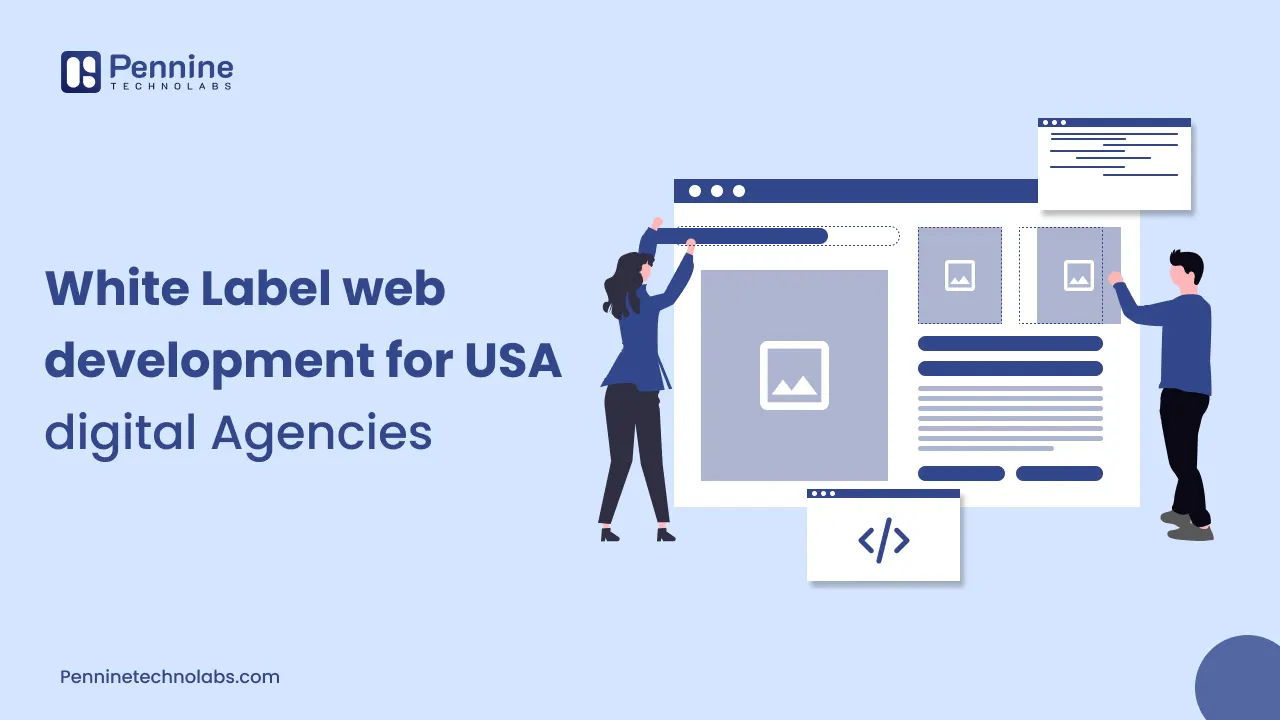
White label web development is an arrangement where a development company builds, codes, and supports websites for a digital agency, and the agency delivers that work to its own clients under its own brand name.
The end client sees your agency’s logo, invoices, and communication. They never see the development partner behind the scenes. You keep the client relationship. Your partner handles the technical execution.
This differs from simply hiring a freelancer. A white label partner works as an extension of your team, following your processes and quality bar, project after project.
When Should a Digital Agency Use a White Label Partner?
A digital agency should consider a white label partner when client demand outpaces internal development capacity, when a project needs a skill the in-house team lacks, or when hiring full-time developers for short-term spikes does not make financial sense.
Common triggers include:
- Seasonal or unpredictable workload. A white label partner absorbs the peaks without you carrying idle payroll during the quiet months.
- Missing technical expertise. Your team may be strong in design and strategy but light on custom WordPress development, headless CMS work, or complex integrations.
- Growth without hiring risk. Expanding your service list, such as offering full website builds alongside your marketing services, without the cost of building a development department.
- Client deadlines that cannot move. When a launch date is fixed and your internal queue is full, extra development hands keep the project on schedule.
How the White Label Model Actually Works
The relationship stays invisible to your client: Your client only interacts with your agency. Project updates, invoices, and support requests all flow through you. The development partner works quietly in the background, often using your agency’s email domain or reporting templates so nothing points back to a third party.
NDA and confidentiality come first: A trustworthy partner signs a non-disclosure agreement before any project details are shared. This protects your client relationships, your pricing, and your business model. If a company hesitates on an NDA, that is a signal to look elsewhere.
Communication and project ownership stay clear: You remain the single point of contact for your client. Internally, you communicate directly with the development team through whatever channel fits your workflow. Ownership of code, credentials, and project files should sit with your agency once a project is delivered.
Scope changes follow a defined process: Client requests change mid-project. A reliable partner has a clear process for scope changes: what gets flagged, how it affects timeline and cost, and how quickly you get an answer.
Freelancer, Outsourcing Company, or White Label Agency: What’s the Difference?
The main difference between a freelancer, an outsourcing company, and a white label development agency comes down to consistency, accountability, and confidentiality.
- A freelancer works alone, often juggling multiple clients, with no backup if they become unavailable mid-project. Confidentiality practices vary and are hard to enforce.
- An outsourcing company provides a team for a defined project, usually with direct communication between your agency and the assigned developers, but branding and confidentiality practices differ by vendor.
- A dedicated white label development agency builds its entire process around staying invisible to your end client. NDAs, branded reporting, and a consistent team are standard practice, not an add-on.
For agencies that resell development work under their own name on an ongoing basis, a dedicated white label partner is generally the more stable choice.
Also read: Outsourcing vs White Label: The Best Model for Your Agency.
Working Across US and India Time Zones
Many white label partners operate out of India, which raises a fair question: does the time difference slow projects down?
In practice, it often speeds them up. A team working while your US-based staff sleeps means work submitted at the end of your day is often ready for review the next morning. Our developers at Pennine Technolabs, for example, share written daily handoffs and keep a short overlap window for urgent US-hours issues, which keeps this arrangement predictable instead of a guessing game.
What to Expect From a Trusted Development Partner
Code quality and development standards: Ask how code is structured, documented, and reviewed before it reaches you. Clean, commented code with a consistent style makes future edits, by your team or another developer, far easier.
WordPress and platform requirements: A large share of white label work involves a white label WordPress agency handling theme customization, plugin development, or CMS setup. Standards here should include WordPress’s official coding practices and its documented security and update guidance, as outlined in the official WordPress documentation.
Responsive development: Every project should be built and tested across common screen sizes and devices before delivery, not adjusted after a client complains.
Accessibility: Website accessibility considerations should follow the Web Content Accessibility Guidelines. According to the W3C Web Accessibility Initiative, WCAG 2.2 conformance is measured at three levels, A, AA, and AAA, and most legal and contractual standards in the US reference Level AA as the practical benchmark.
Core Web Vitals and performance: Google evaluates real-world loading, interactivity, and visual stability through Core Web Vitals. Per Google Search Central, a good experience means Largest Contentful Paint under 2.5 seconds, Interaction to Next Paint under 200 milliseconds, and Cumulative Layout Shift under 0.1. A development partner should treat these as build requirements, not an afterthought.
You might also like: Web Development Best Practices in 2026
Quality assurance and testing: Every project should go through functional testing, cross-browser and cross-device checks, and a security review before it reaches your client. At Pennine Technolabs, this checklist runs on every build before handoff, not just on request.
Scaling capacity during busy periods: One advantage of a white label setup is the ability to add development hands during a busy quarter without a hiring process. Ask how quickly a partner can scale up, and what happens to that capacity once the busy period ends.
Ongoing website support: Websites need updates, backups, and monitoring long after launch. Confirm how issues are logged, prioritized, and resolved. This is where many agency and client relationships either strengthen or quietly fall apart.
Also read: What Is WordPress Website Maintenance?
Warning Signs When Choosing a Partner
Watch for these before signing an agreement:
- Reluctance to sign an NDA or vague answers about confidentiality practices
- No clear process for handling scope changes or missed deadlines
- Pricing that seems too low to cover proper testing and support
- No sample of past work or unwillingness to share references
- Communication that is slow, inconsistent, or routed through unclear contacts
- No documented QA or accessibility process
Any one of these on its own may not be disqualifying, but more than one is a reason to keep looking.
Questions to Ask Before You Start
- What does your NDA and confidentiality process look like?
- Who owns the code and credentials once a project is delivered?
- How do you handle scope changes mid-project?
- What is your QA and testing process before handoff?
- Do you follow WCAG accessibility guidelines and Core Web Vitals benchmarks by default?
- How do you communicate during US business hours?
- What ongoing support options do you offer after launch?
A partner who answers these clearly, without vague reassurances, is worth a closer look.
Choosing the Right Partner for Long-Term Growth
Digital agencies that scale successfully rarely do it by hiring their way through every busy quarter. They build a reliable bench of development capacity they can trust with client work, project after project. Pennine Technolabs, for instance, can flex a project team up within days rather than weeks when an agency’s pipeline suddenly fills.
Pennine Technolabs works with US digital agencies that need dependable capacity without the overhead of an in-house team. Our process is built around NDAs, clear communication, and delivery standards that hold up under your client’s scrutiny, not just ours, whether the need is a single build or ongoing White Label Website Development support.
If your agency needs a White Label Website Development partner for an upcoming project, get in touch with our team to talk through your requirements.