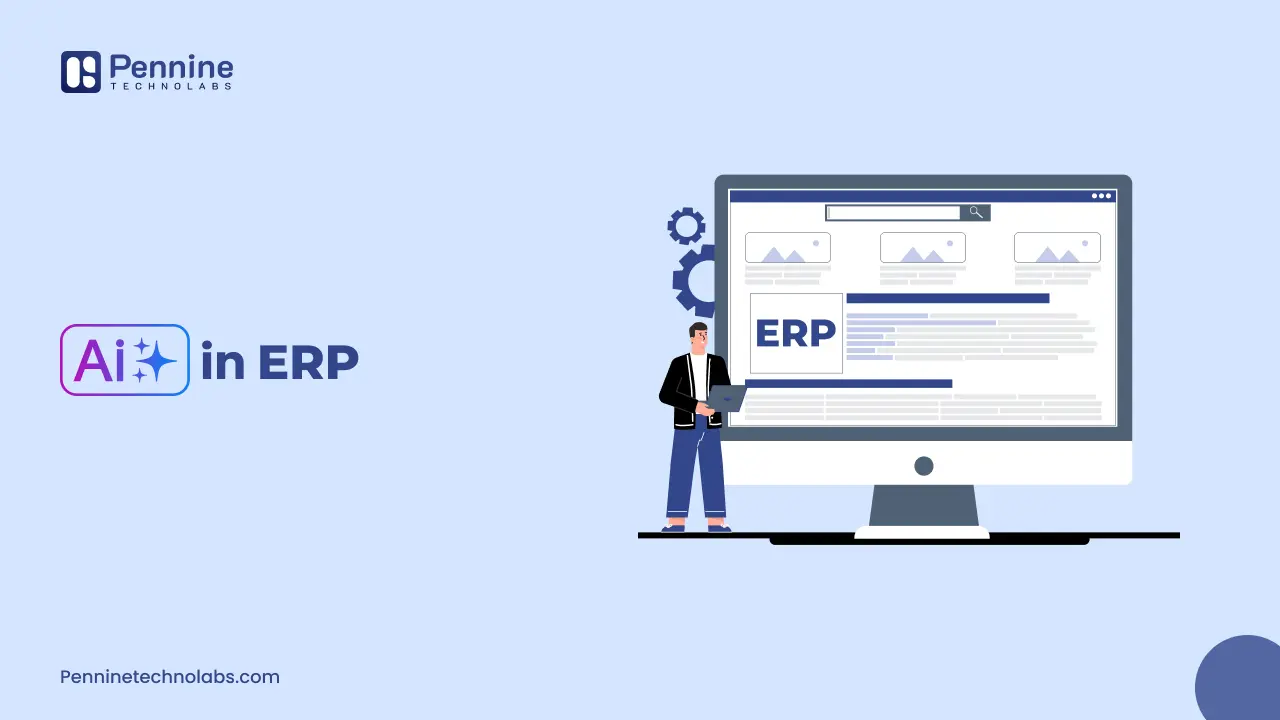
Quick Summary: This guAI is turning ERP from a system of record into a real-time decision engine, automating busywork, predicting risks before they hit, and helping teams move faster. Odoo leads this shift by making AI practical: embedded where work actually happens, and flexible enough to tailor.
Picture Monday morning at 8 a.m. Your finance team isn’t chasing paper invoices or manually reconciling bank statements because an AI assistant already extracted every vendor bill, flagged the anomalies, and suggested a payment schedule. Your sales manager opens the CRM and sees ranked leads with recommended next actions, not just a flat list. Your warehouse supervisor gets a quiet alert that a key raw material will run short in 11 days before the production team even notices.
That’s not a futuristic pitch deck. For a growing number of businesses, it’s Tuesday.
And yet, plenty of companies are still running ERP the old way, using it as a place to record what already happened, then leaning on spreadsheets and gut instinct to decide what to do next. The gap between those two realities is widening fast. When margins are tight and customer expectations are high, reports that arrive after the moment has passed don’t help much. That’s precisely why AI in ERP matters right now: it shortens the distance between data and action, so operations, finance, and sales teams respond in hours, not weeks.
Among the platforms moving fastest in this space, Odoo ERP isn’t just keeping pace; it’s setting the standard.
How AI Is Actually Reshaping ERP Systems
Before diving into what Odoo is doing specifically, it’s worth understanding what “AI in ERP” actually means in practice because the phrase gets thrown around loosely. At its core, AI makes ERP smarter in three distinct ways.
Automation that removes high-friction work
ERP teams quietly spend enormous chunks of time on tasks that are necessary, repetitive, and surprisingly easy to get wrong: retyping invoice fields, routing approvals, updating records, and pushing data between systems. Modern AI can handle all of that, drafting communications, accelerating data entry, and routing work to the right person with fewer clicks. The decision impact is straightforward: fewer manual steps mean faster cycle times, fewer errors, and less burnout, especially in finance operations and customer-facing roles.
Predictive analytics that help you act earlier
Traditional ERP tells you what happened. AI-enhanced ERP helps you see what’s likely to happen next, which customers are trending toward late payment, which SKUs are heading toward a stockout, and which deals are quietly slipping. Industry research consistently points to predictive analytics and demand forecasting as the highest-ROI applications connected to ERP workflows. The operational benefit isn’t glamorous, but it’s real: fewer surprises, fewer emergency purchases, fewer missed renewals.
Decision support that turns ERP into an interactive interface
This is where things get genuinely interesting. The next wave isn’t just better dashboards, it’s the ability to ask a question in plain language, get an answer grounded in your actual company data, and trigger the next step from within the same workflow. Think: “What will our Q3 margins look like if freight costs increase 12 percent?” answered immediately, with context, without opening a separate analytics tool. That kind of capability used to require a data team. Increasingly, it doesn’t.
Why Odoo Stands Out in a Crowded Field
There’s a meaningful difference between ERP vendors that bolt AI onto an existing system and those that build it in by design. Odoo has chosen the latter, and the distinction shows up in how the features actually work in practice.
Rather than treating AI as a premium add-on behind a separate pricing tier, Odoo embeds intelligence directly into the modules users already work in every day. CRM, Accounting, Helpdesk, HR, and Inventory AI agents live inside these screens, learn from your company data, respect your permissions, and improve over time. No separate dashboard, no third-party subscription, no steep re-training curve.
Here’s where that plays out concretely across Odoo AI Features that are already delivering measurable value.
Accounts payable and invoice automation
Manual invoice processing is one of the most obvious places to start because the inefficiency is easy to measure. Odoo’s document digitization uses OCR and AI to extract vendor details, line items, totals, and tax fields from uploaded documents and automatically creates or fills vendor bill records. It can also scan for matching purchase orders to reduce reconciliation mismatches. Businesses that have moved through this transition consistently report faster bill throughput during high-volume periods and significantly fewer “small errors” that create outsized reconciliation work at month-end.
Intelligent CRM and sales support
The CRM module includes an AI sales assistant that learns from historical customer interactions and conversion data. It scores leads with greater accuracy, recommends the next best action: a follow-up call, a personalized offer, a check-in email, and helps sales reps close deals with less second-guessing. For teams managing large pipelines, this alone reduces the amount of time spent deciding who to call next.
Custom AI agents for internal workflows
This is where Odoo Artificial Intelligence is heading, which genuinely separates it from the competition. Odoo’s roadmap includes a dedicated AI app that lets businesses build custom agents using Retrieval-Augmented Generation trained on your own documents, product specs, or internal knowledge bases. These agents don’t just answer questions; they can take real actions within Odoo, such as creating calendar events, routing tickets, or drafting responses in Discuss and Live Chat. A support agent that summarizes account context, suggests a reply, and routes the ticket by urgency that’s not a chatbot. That’s operational infrastructure.
HR and workforce management
Resume parsing, performance tracking, and onboarding workflows are areas where Odoo Development Services increasingly incorporate AI-driven automation. For growing businesses managing large teams across multiple locations, eliminating manual screening alone can save hundreds of hours annually, which HR teams consistently redirect toward higher-value work.
A Reality Check Worth Having
Decision-makers should balance excitement with rigor. Not every AI pilot turns into a production system, and the ones that stall usually do so because the underlying data is messy, the governance model is unclear, or the rollout tried to do too much at once.
A smarter approach looks like this: pick one high-volume workflow where ROI is easy to measure, such as AP invoice digitization, support ticket triage, or lead prioritization. Clean the inputs first (vendor naming conventions, product mapping, purchase order discipline AI amplifies your data quality; it doesn’t fix chaos. Implement with a human-review layer until accuracy is consistently acceptable. Measure weekly. Then expand.
That structured path is also where an expert Odoo developer adds real value, not by wiring in a model and walking away, but by designing the approvals, audit trails, permissions, and change management that make AI stick in daily operations.
About Pennine Technolabs
Pennine Technolabs is a trusted Odoo Development Company in India with a strong track record of delivering intelligent, scalable ERP Services to businesses across the USA, UK, Australia, Germany, and India. Operating from India, our certified Odoo specialists bring both deep technical expertise and genuine business understanding to every engagement.
Whether the goal is a full Odoo implementation, a migration from a legacy system, or targeted expansion of AI capabilities, including automation, custom module development, or third-party integrations, our Odoo ERP Development Services are built around your specific operational reality, not a generic template.
We work as long-term partners, not one-time deployers. From scoping and build through training and post-launch optimization, the focus stays on outcomes: faster cycle times, cleaner data, and teams that actually use what we build. That’s what makes the difference between an ERP project that delivers and one that quietly gathers dust.
FAQs on ERP AI
How is AI changing ERP systems?
AI is turning ERPs from boring filing cabinets into smart teammates that handle the busywork. It automates invoices and predicts trends so you can make fast moves without needing a data degree.
What Odoo AI features can you use today?
You can grab Odoo AI features like auto-invoice scanning and smart lead scoring right now. You can even build custom agents that actually know your products instead of giving generic, robot answers.
Why hire an Odoo development company?
Odoo is easy to use, but setting up AI alone is a total headache. A solid Odoo development company handles the messy tech stuff so you actually see results in months, not years.