Quick Summary: Angular is a powerful framework backed by Google and trusted by enterprises. It is a reliable choice for modern web development. With features like Typescript, two-way binding, and security features, Angular simplifies web apps and ensures long-term maintainability.
Web apps are no longer just simple websites. They power customer onboarding, real-time dashboards, ecommerce transactions, internal operations, and a SaaS platform used by thousands of users daily.
Angular remains one of the most popular front-end frameworks for building large-scale and enterprise applications. According to industry adoption statistics, it is especially popular in the finance, healthcare, and SaaS sectors, where stability and structure are valued more than trends.
Many global companies use Angular to build mission-critical products. Google Cloud Console, Microsoft Office web experiences, and comprehensive fintech dashboards all use Angular web apps to handle complex workflows, role-based access, and data-intensive interfaces.
Angular development services are suitable for businesses developing web applications that are likely to grow over time, and it places a structured framework, predictable releases, and a strong emphasis on code quality. Nor is it designed to address rapid experiments. It is designed to handle products that expand with their users, teams, and evolving business needs.
What is Angular?
Angular is an open-source and TypeScript-based web application framework, maintained by Google. It is designed to build dynamic, single-page applications that prioritize performance, maintainability, and scalability.
AngularJS is a complete framework, unlike lightweight libraries. It provides all the elements needed to build enterprise-grade applications, including routing, state management, form handling, HTTP communication, and testing tools. This all-in-one approach makes Angular appealing to teams with many developers on large projects.
Angular is a component-based architecture. The entire user interface is built as a separate entity, making the application easier to manage, reuse, and scale over time.
Features of Angular
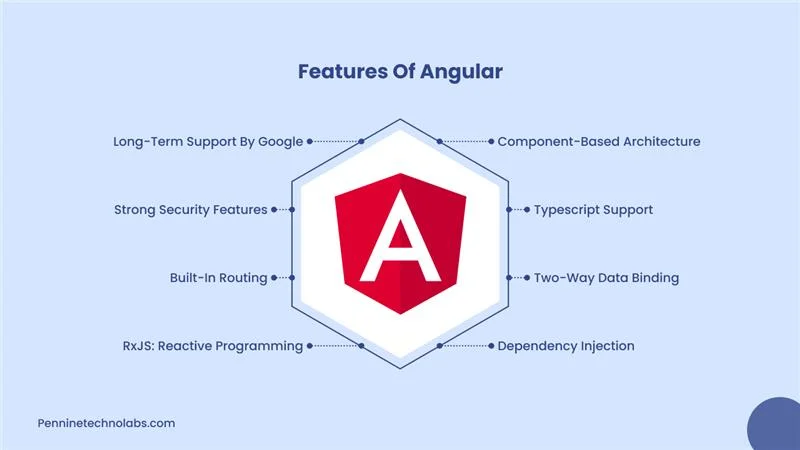
Component-Based Architecture.
Angular is developed based on reusable components. Each of these components has its own logic, templates, and styles. The structure improves code readability and enables teams to work on different sections of the application without any conflicts.
Typescript support
Angular is programmed in TypeScript. Angular contributes strong typing, advanced tooling, and better error detection throughout development. TypeScript helps developers identify problems quickly, resulting in more stable, maintainable applications.
Two-way Data Binding
Angular synchronizes the data model and view. As data changes, the UI updates immediately; when the user interacts with the UI, the data changes as well. This reduces boilerplate code and speeds up development.
Dependency Injection
Angular has a robust built-in dependency injection. It simplifies application testing, scaling, and maintenance by handling component and service dependencies.
RxJS: Reactive Programming
Angular uses RxJS to manage asynchronous operations, such as API calls and user interactions. It simplifies the complexity of data flows and the development of responsive user experiences.
Built-in Routing
Angular offers a robust routing system that enables smooth navigation in single-page applications. It supports lazy loading, making it faster and more performance-optimized.
Strong Security Features
Angular shields the application against the most frequent vulnerabilities, including cross-site scripting and injection attacks. It is a robust option for sensitive applications, with built-in sanitisation and secure coding practices.
Long-term Support by Google
Angular is actively updated and patched for security and performance. This long-term support will give businesses confidence to invest in Angular-based solutions.
Angular Version History
Angular development has improved significantly over the years, with a focus on stability, developer experience, and performance.
AngularJS introduced the concepts of data binding and the MVC architectural pattern.
Angular 2 was a radical redesign and uses TypeScript and component-based architecture.
Angular 4 improved performance and reduced application size.
Angular 6 introduced improvements to Angular CLI and enhanced tooling.
Angular 8 emphasized Ivy preview and speedy builds.
Angular 9 released the Ivy compiler, which improved rendering performance and reduced the bundle size.
Angular 12 simplified construction and eliminated legacy support.
Angular 14 introduced typed forms and standalone components.
Angular 15 and later versions enhance developer productivity, performance, and support of current web standards.
Angular 16 introduced significant improvements, including signals for fine-grained reactivity, faster change detection, better server-side rendering, and improved hydration support.
Angular 17 focuses on developer productivity and build performance. It introduced a new control-flow syntax, faster builds with better tooling, and more significant support for modern rendering strategies.
Angular 18 continues to refine performance, stability, and developer experience with improved signals, tooling enhancements, and long-term maintenance updates.
Angular 19 and Angular 20 focused on framework stability, performance tuning, and enterprise readiness, ensuring that Angular remains a future-proof choice for large-scale web applications. Get in-depth knowledge with: What’s New in Angular 20
This consistent evolution renders Angular a future-ready framework.
Why Choose Angular for Web Development
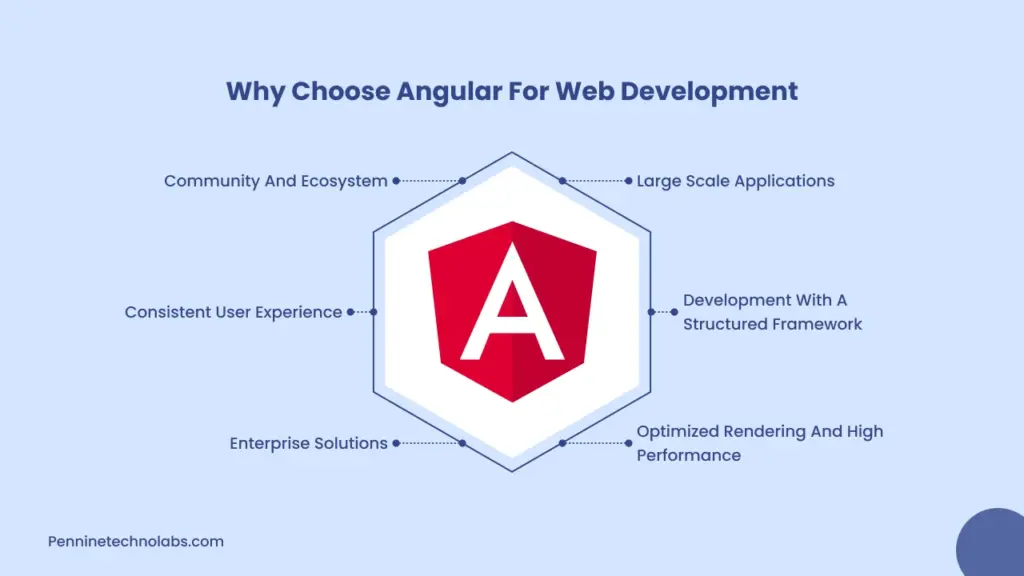
Large Scale Applications
Angular is designed to accommodate complex software with numerous modules, capabilities, and user identities. Its structure helps teams manage large codebases without losing control.
Development with a Structured Framework
Angular is easy to use with built-in functionality and an easy-to-understand architecture. AngularJS Developers spend less time choosing libraries and more time on feature development.
Optimized Rendering and High Performance
Angular has fast change detection and lazy loading, which makes it perform well even in applications with heavy data.
Enterprise Solutions
Businesses widely adopt Angular for its stability, long-term support, and security features. It works with rigid codes and massive development teams.
Consistent User Experience
Angular helps build rapid, interactive, cross-platform, cross-browser user interfaces.
Community and Ecosystem
Angular has a large community and is well-documented, with a wide range of third-party providers worldwide. It facilitates easy solution finding, tools, and competent developers.
When Not to Use Angular?
An Angular Web App is not suitable for every project.
- Angular might be heavy for a simple landing page or small websites.
- If your team is new to TypeScript or structured frameworks, initial development can be slowed by the learning curve.
- Simple libraries might be helpful for projects that require extremely lightweight JavaScript.
- In this situation, alternatives such as React or Vue may be more appropriate depending on the project scope.
How Pennine Technolabs Uses Angular Development in Varied Industries
At Pennine Technolabs, Angular web development plays a key role in building scalable, secure web applications across diverse industries.
- Angular is widely used in the healthcare industry to build secure dashboards, patient portals, and data-driven applications, where reliability and security are paramount.
- For e-commerce websites, Angular enables fast product browsing, dynamic filters, and a seamless checkout process, all of which enhance conversions.
- Angular is useful in the financial and fintech sectors in creating real-time data visualisation and finding secure transaction interfaces.
- Angular is a robust solution for enterprise and SaaS products that require complex workflows, role-based access, and long-term scalability.
- Pennine Technolabs employs Angular to deliver full-stack solutions built on robust backend technologies aligned with business objectives.
Hire Angular Developer from India
Our Angular developers collaborate with clients to understand workflows, user behaviour, and growth strategy before a single line of code is written. It ensures application architecture can be expanded in the future without incurring expensive rewrites.
Hire AngularJS expert to build enterprise-grade dashboards, SaaS, ecommerce, and custom web portals with ease, even when the logic is complex. Clean component structures, optimized change detection, and secure coding practices are common across all projects.
Businesses choose Pennine Technolabs Angular development because we offer
- Deep experience in various industries.
- Focus on performance, security, and scalability.
- Maintainable and clean Angular code that matches best practices.
- Flexible engagement models for companies and businesses (small scale).
If you are planning to develop or expand an Angular-based web application, collaborating with Pennine Technolabs will give you a team knowledgeable about the technology and business deliverables.
Conclusion
Angular is an efficient framework that is constructed on the principles of modern, scalable, and secure web-based applications. Its organized methodology, advanced equipment, and extensive assistance make it the preferred choice for companies seeking development and stability.
Angular is not suitable for all small projects, but it excels at enterprise-grade applications that require speed, reliability, and maintainability.
Hire AngularJS Developers from India who offer services in the USA, UK, and across the globe with proper knowledge, skills and are affordable for companies.
If you are planning to build a future-ready web application, choosing Pennine Technolabs Angular developers for hire can get you achieve faster delivery, better quality, and long-term success.
FAQs for Angular Development
What is Angular used for in Web Development?
Angular web development provides a complete framework for building scalable and structured web applications. It helps manage complex logic, large codebases, and long-term maintenance with ease. Businesses rely on Angular for stability, performance, and consistent development practices.
What are the advantages of using Angular?
Angular offers a component based architecture, strong TypeScript support, and built in security features. It improves code quality, performance, and team collaboration. Long term support from Google makes it a reliable choice for growing applications.
What are some of the reasons you would choose to use AngularJS in your project?
Angular is ideal for projects with complex workflows, multiple user roles, and future scalability needs. It suits applications that require performance, maintainability, and structured development. Teams also choose Angular for enterprise level consistency.
Is Angular suitable for small projects?
Angular can work for small projects, but it may feel heavy for very simple applications. Its true value appears in medium to large-scale projects. For lightweight websites, simpler frameworks may be more practical.
Why hire Angular developers from Pennine Technolabs?
Pennine Technolabs offers experienced Angular developers focused on scalable and secure development. We build business-driven Angular applications across multiple industries. Our approach ensures long term performance and maintainability.