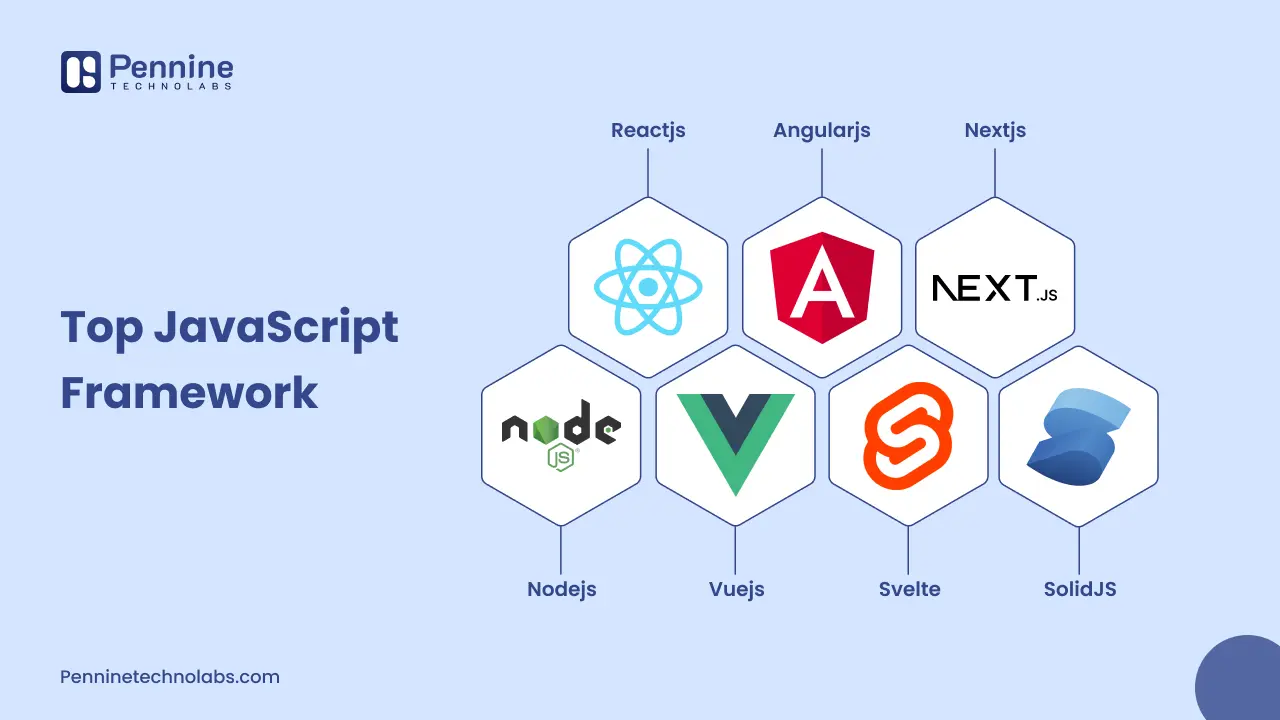
Quick Summary: Choosing the proper JavaScript framework in 2026 is no longer about trends alone. It is about performance, long-term support, developer productivity, ecosystem strength, and how well the framework aligns with your product vision. In this guide, we break down the top JavaScript frameworks that are shaping modern web development, including ReactJS, AngularJS, Next.js, Node.js, Vue.js, Svelte, and SolidJS.
JavaScript is a development and programming language. JavaScript is no longer a simple scripting language that was used to validate forms, but the foundation of a modern web application. JavaScript nowadays can be used in dynamic websites and dashboard applications, real-time applications, SaaS platforms, and even back-end systems.
JavaScript is unique and has a universal presence. It runs in the browser, on the server, and on devices. JavaScript development has become more scalable, structured, and fast with the development of frameworks and libraries. By 2026, businesses anticipate that applications will be fast and operate efficiently on devices and be responsive to user feedback. JavaScript frameworks contribute significantly to the fulfillment of these expectations.
Pennine Technolabs specializes in partnering with international clients in order to develop scalable web applications powered by JavaScript, but performance-oriented and future-oriented. The most strategic decision we will always guide our clients on is the selection of the appropriate framework.
What is a JavaScript Framework?
A JavaScript framework is an organized framework that assists developers in creating web applications more effectively. The framework gives pre-built components, standard patterns, and optimized tools that developers use instead of scratch work.
Frameworks solve common issues like state management, UI rendering, routing, data handling, and performance optimization. They also promote best practices, which makes web application scaling easier to maintain and scale over time.
Simply, a JavaScript framework saves time, enhances the quality of code, and provides consistency throughout the application.
Why do Web Developers choose JavaScript frameworks?
Web Developers and businesses choose JavaScript frameworks for all the practical reasons.
Frameworks enhance web development speed. Teams can deliver features at a high rate without affecting the quality.
Second, frameworks offer scalability. Structured codebases are essential with the increasing applications.
Third, there are powerful communities and ecosystems with dedicated frameworks. This is in terms of improved documentation, third-party libraries, and long-term support.
Fourth, frameworks enhance performance and user experience upon proper use.
Lastly, the modern frameworks are compatible with SEO, Core Web Vitals, and Google AI-driven search results in case they have the correct architecture.
Top JavaScript Frameworks to Choose in 2026
ReactJS Framework
ReactJS is among the most popular JavaScript libraries used in Web development. Backed by Meta, React still dominates the front-end development in 2026 as it is flexible, fast, and has a vast ecosystem. It is a popular component in SaaS, dashboards, and large-scale web applications. According to recent surveys by web developers, React contributes more than forty percent of professional frontend developers across the globe.
ReactJS Key Features
- Component-based architecture for reusable UI elements
- Virtual DOM for efficient rendering and performance
- Rich ecosystem with state management and data handling libraries
- Supports server-side rendering through Next.js
- Strong backing and long-term roadmap from Meta
ReactJS Advantages
- Ideal for scalable and dynamic user interfaces
- Large talent pool and strong community support
- Flexible architecture for startups and enterprises
- Easy integration with modern backend systems
- Proven stability for long-term projects
Pennine Technolabs applies the concept of ReactJS web development to develop scalable front-end applications that work hand in hand with the current backend systems.
AngularJS Framework
AngularJS is a robust enterprise-centered JavaScript framework maintained by Google. It is suitable for large-scale and complex web applications where structure and maintainability are critical. Angular remains a popular project when it comes to enterprise apps, particularly in the finance and health sectors in 2026. A substantial portion of Fortune level uses Angular as an internal and customer-facing application.
AngularJS Key Features
- Complete MVC model with robust architecture patterns
- TypeScript was developed development for better code quality.
- Built-in dependency injector to have scalable systems
- Advanced CLI for development, testing, and deployment
- Full-term support by Google.
AngularJS Advantages
- Better in the enterprise-grade applications,
- Long-term developability, consistent structure between large teams
- Complex business logic is handled well.
- Reliable frameworks for mission-critical systems.
Pennine Technolabs recommends Angular web development for long-term enterprise projects, where stability and structure are considered.
Next.js Framework
Next.js is a new framework created on the React framework, designed for performance, SEO, and scalability. It has emerged as one of the most popular business options among those who desire speed in loading websites and good search results. Next.js is widely adopted by the majority of startups and companies developing content-driven platforms and ecommerce websites in 2026. The usage has been on the increase because it is compatible with the Core Web Vitals and Google AI search.
Next.js Key Features
- Built-in routing and API support
- Server-side rendering and static site generation
- Built-in support for headless CMS architectures
- Excellent Core Web Vitals performance
- Native support of headless CMS architectures
- Automatic image and performance optimization
Next.js Advantages
- Optimized SEO
- Ideal for content-driven and online shopping sites
- Production capable framework with minimal configuration
- Improves visibility on Google SERP and AI search
- Scales smoothly from startup to enterprise
Pennine Technolabs also extensively employs Next.js to create fast and efficient websites that perform great on Google SERP and the AI-powered search engines.
Node.js Framework
Node.js is a JavaScript runtime that allows developers to create high-performance, easily scalable back-end applications. It enables the usage of JavaScript on the frontend and the backend, removing full-stack development. Node.js is used to compute a significant part of contemporary APIs, microservices, and real-time applications in 2026. Numerous web-based systems that feature heavy traffic are based on Node.js on account of its performance and scalability.
Node.js Key Features
- Event-driven and non-blocking architecture
- JavaScript-based backend development
- Massive NPM package Ecosystem
- Supports API driven systems and microservice-based systems
- Ideal to use in a time application
Node.js Advantages
- High-performance, scalable backend system
- Faster development based on one language stack
- Real-time applications, data-intensive applications
- Strong community and enterprise adoption
- Cost-effective with growing applications
Pennine Technolabs develops a strong backend system with Node.js that can be used to facilitate scalable and secure applications.
Vue.js Framework
Vue.js is a progressive JavaScript framework known for its simplicity and flexibility. It is widely adopted by startups and mid sized teams that want fast development without complexity. In 2026, Vue continues to grow steadily, especially in Asia and Europe. Its balanced approach makes it suitable for both small applications and scalable platforms.
Vue.js Key Features
- Reactive data binding for real time UI updates
- Component based development model
- Flexible integration with existing projects
- Clean and readable syntax
- Strong documentation and tooling
Vue.js Advantages
- Easy learning curve for developers
- Faster development cycles
- Balanced performance and simplicity
- Suitable for a wide range of applications
- Growing global ecosystem
Pennine Technolabs recommends Vue.js for projects that need fast development without heavy architectural overhead.
Vue.js Framework
Vue.js is a progressive JavaScript framework known for simplicity and flexibility. It is popular with startups and medium-sized teams who desire rapid development without being complicated. Vue is also steadily expanding in 2026, particularly in Asia and Europe. It is also more than just a small application, as it is a scalable platform.
Vue.js Key Features
- Reactive data binding for real-time UI updates
- Component-based development model
- Flexible integration with existing projects
- Clean and readable syntax
- Strong documentation and tooling
Vue.js Advantages
- Easy learning curve for developers
- Faster development cycles
- Balanced performance and simplicity
- Suitable for a wide range of applications
- Growing global ecosystem
Pennine Technolabs suggests Vue.js for applications that require rapid development and do not have significant architectural demands.
Svelte Framework
Svelte is a new JavaScript library, that moves a significant part of the work to the build process instead of the browser. This leads to remarkably optimized and lightweight applications. Svelte is also picking up pace with performance-oriented teams and startups in 2026. It has a faster load time and better code.
Svelte Key Features
- Compile-time optimization instead of runtime processing.
- No virtual DOM for faster execution
- Minimal runtime overhead
- Simple and readable syntax
- Highly optimized output code
Svelte Advantages
- Exceptional performance and speed
- Smaller bundle sizes for faster loading
- Cleaner code with less boilerplate
- Ideal for performance-critical applications
- Excellent developer experience
Svelte is used electively in Pennine Technolabs when the desire to develop fast, no-frills projects is paramount.
SolidJS Framework
SolidJS is a high-performance JavaScript framework focused on fine-grained reactivity. It combines modern reactive concepts with an efficient execution model. In 2026, SolidJS is emerging as a strong option for developers who prioritize speed and control. Its adoption is growing among advanced JavaScript teams.
SolidJS Key Features
- Fine-grained reactivity for precise updates
- No virtual DOM for maximum performance
- JSX-based syntax similar to React
- Efficient memory usage
- Modern reactive programming model
SolidJS Advantages
- High-speed rendering performance
- Lightweight and efficient architecture
- Familiar syntax for React developers
- Ideal for next-generation web applications
- Strong potential for future adoption
Pennine Technolabs monitors SolidJS closely and evaluates it for next-generation applications.
How to Choose the Best JavaScript Framework for Your Application
Choosing the best JavaScript framework depends on your business goals rather than trends.
Check out your application type. Next.js is better with content-driven platforms, whereas more complicated dashboards might be better with Angular.
Evaluate team expertise. An established framework minimizes the time and cost of onboarding.
Consider scalability and maintenance. Structured frameworks support long-term growth.
Focus on performance and SEO. Frameworks that aid server rendering are more effective in search and AI discovery.
Assess ecosystem maturity. A good ecosystem brings about long-term reliability.
Pennine Technolabs have a proper decision process so that the framework adopted can meet the needs of the present and the future.
Conclusion
In 2026, there is no single best JavaScript framework for every project. ReactJS and Next.js dominate modern web development, Angular remains strong for enterprise systems, Node.js powers scalable backends, Vue offers simplicity, and emerging frameworks like Svelte and SolidJS push performance boundaries.
The right choice depends on your product vision, team strength, and growth strategy. Businesses that align technology decisions with long-term goals gain a clear competitive advantage.
If you are planning to build or modernize a JavaScript-driven application, Pennine Technolabs can help you choose the proper framework and deliver a scalable, SEO optimized, and future-ready solution.