Quick Summary: Expanding companies can choose between SaaS applications and in-house development. This blog elaborates on how these differences were crucial, cost and scalability factors, and the long-term implications of decisions, enabling decision-makers to select the appropriate solution for sustainable growth.
As the business grows, its technological requirements become increasingly complex. Some processes used in the early years may no longer support expansion, automation, and efficiency. At this stage, many organizations face a dilemma: whether to continue relying on SaaS applications or to have web applications tailored.
Both alternatives favour digital operations; however, they have different business objectives. SaaS products are quick and convenient, whereas bespoke web applications are only flexible and controllable in the long run. Understanding this difference will enable business owners to make rational decisions that support growth, scalability, and performance.
Such a comparison is particularly critical for enterprises that intend to systematically grow their business and initiate a sequence of digital investments.
Understanding SaaS Tools and Custom Web Applications
It is necessary to understand what each option provides before comparing the two approaches to the issue.
SaaS is pre-assembled software delivered on a subscription basis. These mechanisms are intended to have broad adoption and rapid uptake.
Custom web application development are developed to align with the company’s work, processes, and objectives. In tailored web application development, businesses can design solutions that perfectly fit their operating model.
The two models favor digital transformation, though the positive effects on scalability and control vary widely.
Most expanding businesses prefer to hire web application developers to build solutions aligned with their business objectives.
Why This Decision Matters for Growing Businesses
As team sizes increase and the process matures, custom software development become even more pronounced. An inclination to misconstrue the system can lead to inefficiency, higher costs, and operational bottlenecks.
This choice has a direct impact on the following:
- Process efficiency
- Automation capabilities
- Cost predictability
- Long-term scalability
Software must not limit expansions, but be able to sustain them in growing organizations.
What Are SaaS Tools?
SaaS refers to software services offered on a subscription basis by third-party providers, who maintain and manage the service. Customers, accounting, and tracking tasks are widely implemented through them.
Major features of SaaS Tools.
- Fast implementation
- Lower initial cost
- Limited customization
- Vendor-controlled updates
Businesses with standard operations and those with short-term needs often use SaaS services.
Key Characteristics of SaaS Tools
Unique solutions are developed to meet specific business requirements. These applications are flexible within internal processes, unlike SaaS tools, which would require businesses to modify their workflows.
Web Application Development gives companies complete control over features, performance, and integrations.
Major Accounts of Custom Solutions.
- Tailored workflows
- Full ownership
- Flexible scaling
- Better long-term alignment
Businesses typically outsource web application development to reduce costs and access specialized expertise while maintaining quality and control.
Tailor-made systems are best suited to scenarios where the business is expected to grow over the long term.
What Is Custom Web Application Development?
Custom web application development involves designing and building tailored solutions to meet the specific needs of a business. Unlike SaaS tools, which often require companies to adapt their operations to fit the software, custom applications are flexible and align seamlessly with existing internal processes.
Web Application Development gives companies full control over features, integration, and performance.
The main unique features of Custom Solutions.
- Tailored workflows
- Full ownership
- Flexible scaling
- Better long-term alignment
Businesses outsource web application development to minimize costs, acquire specialized skills, maintain quality standards, and retain control.
The ideal systems are custom systems used when a firm intends to achieve sustained growth.
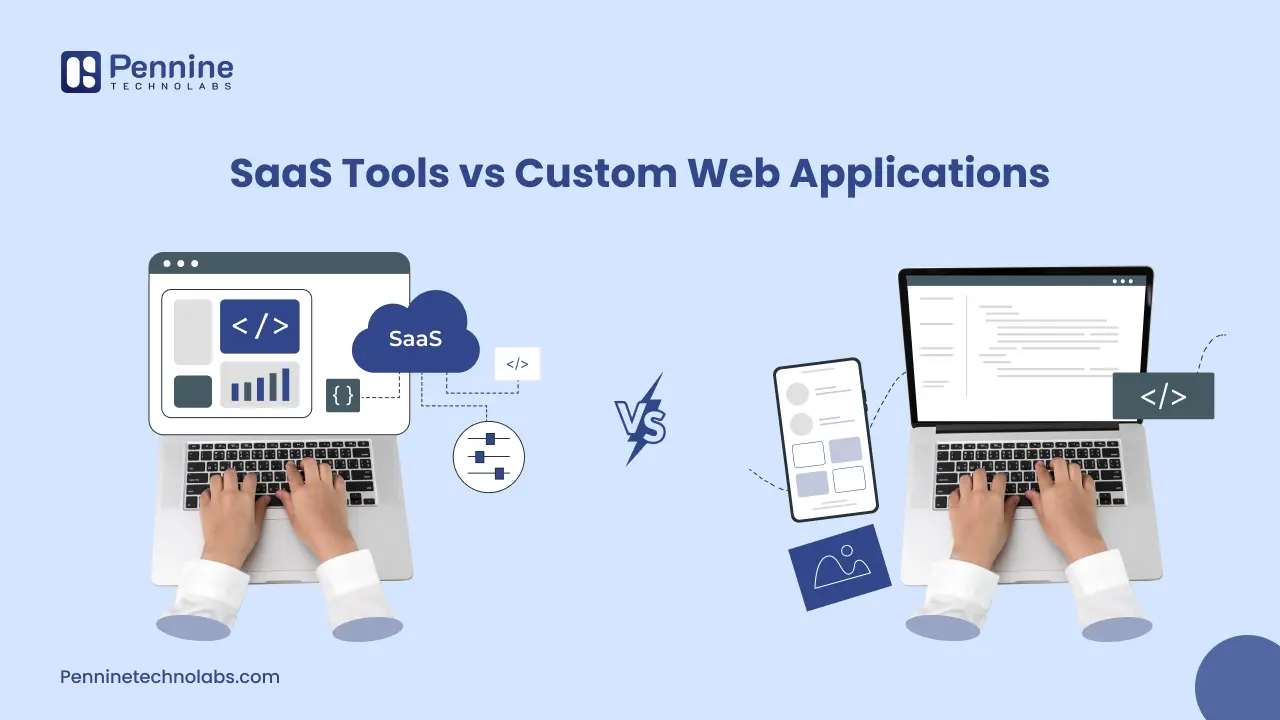
SaaS Tools vs Custom Web Applications: Core Differences
| Feature | SaaS Tools | Custom Web Applications |
|---|---|---|
| Customization | Limited | Fully tailored |
| Ownership | Vendor-managed | Business-owned |
| Scalability | Plan-dependent | Growth-ready |
| Integration | Restricted | Seamless |
| Cost Structure | Recurring fees | Predictable investment |
This comparison shows why the decision goes beyond short-term convenience.
Cost Considerations: Short-Term vs Long-Term
At first glance, SaaS tools appear cost-effective. Businesses can easily adopt subscription-based pricing without a significant capital investment. For small teams, monthly or annual payments can be considered at the earliest stage of development.
However, this step will also increase costs as the company expands. The need to add more users, activate more premium features, or increase storage is often accompanied by an upgrade to a higher subscription tier. However, in the long run, such recurrent costs are likely to be unpredictable and uncontrollable.
Tailor-made solutions are normally expensive to invest in. The costs encompass planning, development, testing, and deployment. This will be costly initially, but long-term costs will be more predictable and less volatile. Companies avoid subscription rate increases and retain full server ownership.
Contracting with a software development company with experience helps organizations strike the right balance between initial expenditures and long-term value. Tailored solutions can be more cost-effective and deliver high ROI over the long term for a developing company.
Scalability and Business Flexibility
Scalability is a major challenge in business development. SaaS is often restrictive in terms of feature usage, capacity, and the ability to upgrade to a higher tier.
Custom solutions provide:
- Flexible user scaling
- Conditional expansion feature.
- Flexibility in the workflow according to the demands.
This is why enterprise web applications are a viable option for institutions striving to grow over the long term.
Automation and Workflow Efficiency
Productivity improvement depends on automation. SaaS tools facilitate overall automation but may not align with individual operational requirements.
Custom web solutions enable:
- Facilitating an end-to-end workflow automation.
- Role-based access control
- Process-specific reporting
Application Software Development focuses on creating custom solutions that automate processes, enable connectivity, and support business growth.
Speed to Implementation vs Strategic Fit
One reason businesses adopt SaaS tools is speed. This allows such platforms to go live within days, or even hours, so teams can start using the software with minimal configuration. The company finds this fast implementation appealing to companies with urgent operational needs.
Speed should not be confused with long-term suitability. SaaS tools are also easy to adopt, but they may not scale well to changes in workflow or business needs. Over time, businesses may require workarounds, extensions, or additional tools to address functional gaps.
Custom web applications take longer to plan and develop than software, but they are built with strategic alignment in mind. Such solutions should be aligned with business goals, operations, and development strategies. The first implementation takes more time but yields a more appropriate system that will save time going forward. Expanding companies require striking a balance between expediency and long-term strategy. A solution that can support future expansion is normally more valuable than one that is fast to install.
Bespoke solutions have managed updates and custom maintenance. Companies that use Web Application Development Services benefit from long-term stability, security, and reliability.
When SaaS Tools are the Right Choice :
SaaS tools work well when:
- Business needs are simple
- Speed is a priority
- Budget constraints exist
- There are no requirements for custom workflows.
Their application is typically appropriate for start-up companies.
When Custom Web Applications Are the Better Choice:
Individual solutions are desirable in the following cases:
- Processes are unique
- Automation is critical
- Data ownership matters
- Scalability over the long term is required.
Most businesses that grow beyond SaaS eventually abandon it.
Role of Application Modernization in Growing Businesses
Systems performance and scaling issues arise as systems age. Application Modernization helps businesses update their current platforms to meet emerging requirements.
Using Application Modernization Services, organizations enhance security, performance, and integration without recreating their systems.
The systems have been modernized to support the Software Applications and long-term growth.
Supporting Scalable Digital Growth
The key question is how to select the appropriate technology partner to achieve long-term success. Pennine helps companies achieve their growth goals by providing scalable, secure digital solutions.
- Helps enhance operational efficiency and automation.
- Develops flexible, growth-oriented platforms.
- Favors upgrading the system support.
- Provides international services that are developed in India.
The scalable business software enables organizations to scale users, features, and processes without impacting system performance.
Conclusion
The decision between SaaS solutions and in-house web applications is driven by business objectives, growth, and future perspectives. SaaS systems are fast to deploy and not complex, whereas custom applications are versatile, offer greater control, and can be scaled.
Pennine Technolabs Custom Software development can be more valuable for businesses that require long-term efficiency, automation, and ownership. By applying the appropriate technology selection process, business strategy, and alignment, the organization can develop systems that drive sustainable growth and competitive advantage.