Quick Summary: If you are beginning your journey into web development, PHP is one of the easiest and most practical languages to start with. This guide walks you through what PHP is, why it matters, and how to set it up with the essential concepts every beginner needs to build dynamic websites confidently.
PHP is among the most reliable and easiest languages to start with if you are entering the world of web development. Thousands of developers choose PHP because it is easy, customizable, and has a lot of support on the host platforms. Some of the most popular software, including WordPress, Magento, Drupal, and Laravel, run on PHP.
Whether you are developing your own project or a full-scale application based on business, PHP website development provides you with a good basic platform that is typical of knowing how websites work within the background.
What is PHP for Web Development?
PHP is Hypertext Preprocessor. It is a server-side scripting language that assists developers in building dynamic website and applications. In comparison with HTML, which only shows existing data, PHP development executes logic on the server, e.g., user log-in, form submission, database interaction, or money transfer, and then delivers the response to an output.
Simply, the content is shown using HTML. PHP renders the content intelligent and active.
Why is PHP used for Web Development?
PHP is a well-known web technology for being realistic and simple to adopt. Web Developers and companies still prefer PHP because of the following reasons.
- Beginner-friendly learning curve
- Easy to get along with MySQL as well as with other databases.
- Working with nearly all hosting environments.
- Strong community support
- Protect through development best practices.
- Scales both small websites and enterprise applications.
The other factor that keeps PHP relevant is its ecosystem. PHP still powers Laravel framework and WordPress CMS, and it is powering around 75% of the web.
PHP Web Development Tools
A good development environment makes learning faster. Notable tools of PHP development include:
- XAMPP and WAMP to create a local server.
- Composer for package management
- Hosting and deployment on Laravel Forge or cPanel.
- phpMyAdmin database management.
- PHPUnit Testing and debugging.
- Code editors
- Version control
- Package managers
- Debugging tools
These tools facilitate the development process and assist in automating the process, which would otherwise require a lot of manual work.
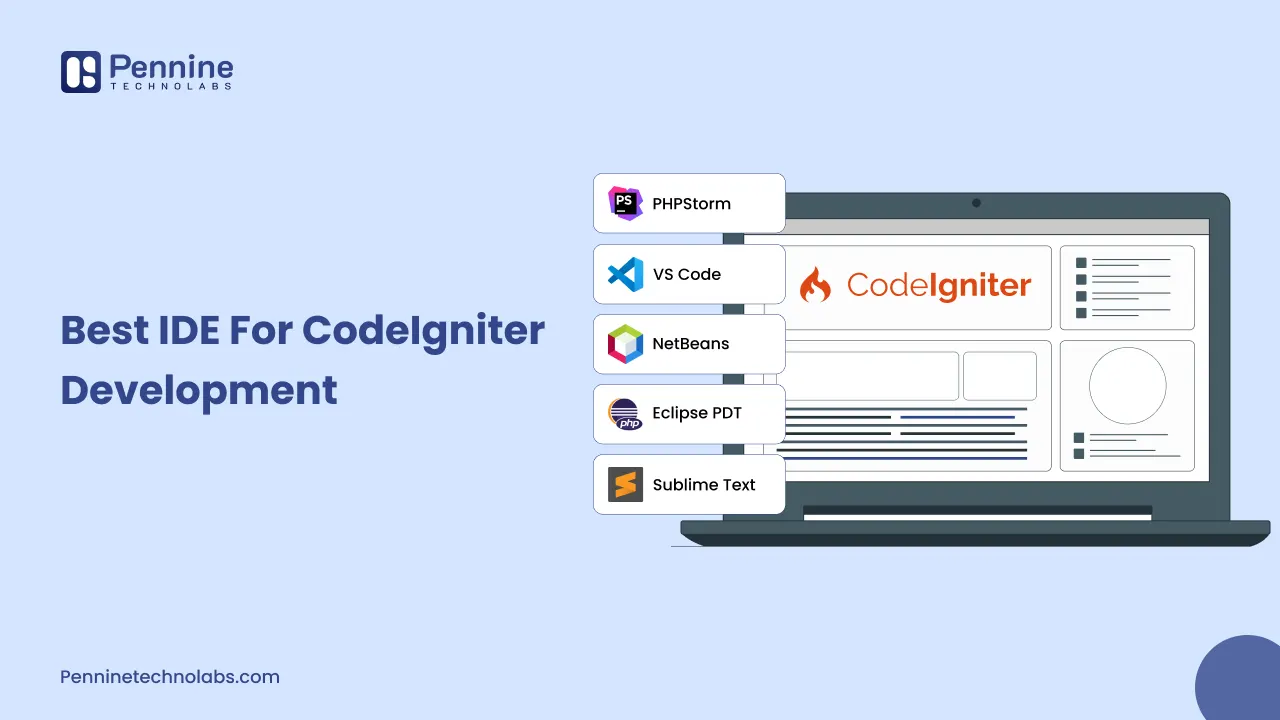
Top PHP IDEs for Web Development.
A coding environment is comfortable, which saves time and enhances accuracy. PHP Website Developers prefer these IDEs.
- PhpStorm
- Visual Studio Code
- Sublime Text
- Eclipse PDT
- NetBeans
These IDEs have autocomplete features, syntax highlighting, built-in debugging, and support for frameworks such as Laravel and Symphony.
Getting Started with PHP for Web Development
Get a proper working environment before you write your first script.
- Requirements of the PHP Setup version.
- To start building PHP based applications, you require:
- Local server environment such as XAMPP, MAMP or WAMP.
- A code editor or IDE
- Basic knowledge of HTML and CSS.
- An optional database system e.g. MySQL or MariaDB.
After the installation, all one needs to do is create a file with the .php extension and place it in the server directory, often referred to as htdocs or www. Subsequently, open it with your browser with a URL like: localhost/yourfilename.php
PHP Basics for Web Development
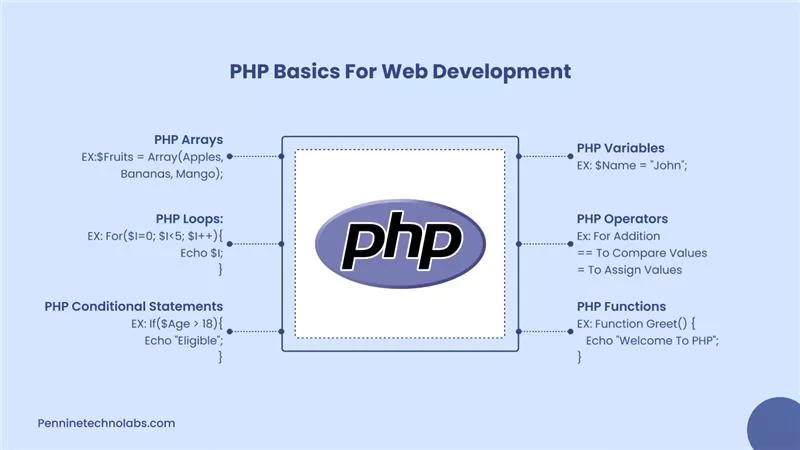
When you are ready, begin the study of fundamental blocks of the language.
PHP Variables
Variables hold data in the form of text, numbers, or values that are in a form. PHP has all variables beginning with a dollar sign.
Example
$name = "John";PHP Operators
Calculations or comparisons are done with the help of the operators.
Examples
for addition
== to compare values
= to assign values
PHP Functions
Functions enable you to have reusable blocks of code, and thus you do not repeat yourself.
Example
function greet() {

   echo "Welcome to PHP";

}
PHP Conditional Statements
The program makes decisions with the assistance of conditional statements.
Example
if($age > 18){

   echo "Eligible";

}
PHP Loops
Repetitions can be seen as loops where the action repeats until a condition is reached.
Example
for($i=0; $i<5; $i++){

   echo $i;

}
PHP Arrays
Lots of values are held in arrays under one variable.
Example
$fruits = array(Apples, bananas, mango);These fundamental skills are a stepping stone to the higher levels of understanding, such as object-oriented programming, database work, authentication of users, and the creation of full-scale applications.
PHP Frameworks You Should Learn
Modern PHP development is dependent on frameworks. The frameworks assist developers in writing cleaner code, enhancing security, and accelerating growth.
These are the best PHP frameworks you ought to know.
Laravel PHP Framework
Laravel is the most popular PHP framework for the development of modern web applications. It is based on the MVC model, and it provides built-in functionalities, routing, authentication, caching and database management.
Laravel is popular because it:
- Streamlines the complicated development task.
- Offers excellent security capabilities.
- Has a large and supported ecosystem.
- It is suitable for friendly and enterprise applications.
Laravel is often the first choice for developers who create scalable and maintainable PHP applications.
CodeIgniter PHP Framework
CodeIgniter is a lightweight PHP framework known for simplicity and speed. It is easy and suitable for developing projects with rapid development and minimal configuration.
CodeIgniter is ideal for:
- Small to medium web applications
- Projects with limited server resources
- Developers who prefer simplicity and control
It is an oriented framework that is suitable for lightweight PHP applications.
Symfony PHP Framework
Symfony is a strong PHP framework designed for large-scale and enterprise-grade applications. It is very flexible and adheres to the best code.
Symfony is commonly used for:
- Enterprise applications are complex.
- High traffic websites
- Large and long-term development projects.
Symfony is based on reusable objects and robust architecture, which is appropriate for professional and enterprise-level development on PHP.
Best Practices for Using PHP in Web Development
Pennine PHP web development services create scalable and secure applications. These are some of the core habits that are to be practiced at an early age.
- Always authenticate and cleanse user inputs.
- Do not put unnecessary logic in one file.
- Apply MVC architecture when dealing with big projects.
- Passwords in stores are safely stored using hash messages.
- Maintain PHP at the current stable level.
- Use Composer for dependency management.
- Have adequate user-handling and logging.
The distinction between a simple script and a production-ready system is good structure and good security habits.
What Can You Build After Learning PHP?
Once you learn PHP, you can create numerous real-world web solutions, from a simple website to a complex web application. PHP is beneficial since it is compatible with databases, servers, and modern frameworks.
With PHP skills, you can build:
- Custom dynamic business websites.
- Blogging Platforms and Content Management Systems.
- eCommerce sites that are payment gateway integrated.
- Dashboards, portals, CRMs, etc.
- Mobile and front-end REST API.
PHP is applicable in small projects as well as large-scale applications, which makes it a viable skill to use in long-term web development jobs.
Conclusion
PHP Development in the USA still stands and will always be the best starting point for anyone developing a web application. It is simple to learn, is extensively supported, and has a solid community. Once you feel more at ease with PHP, you can look into such advanced fields as APIs, developing with Laravel, developing with WordPress, and deploying to the cloud.
In case of a need to build the applications on a PHP-based platform, or integrating the framework or scaling out an already built system, Pennine Technolabs can help you with hands-on development experience.
FAQs for PHP Web Development
What is PHP in Web development?
PHP is a server-side scripting language used in web development. It deals with the background work like database communication, form treatment, authentication and content control.
How to create a dynamic blog using Laravel PHP?
One has to set up a project with Laravel, a database, and models and migrations are created to handle posts, controllers are made to handle logic, and views are built with Blade templates. Laravel also has built-in authentication, routing, and security capabilities.
How to develop a website in PHP?
Develop a PHP-powered site, a local server environment should be installed, PHP scripts to do the logic in the back end are to be written, the site should be linked to a database and HTML, CSS and JavaScript should be used as the front-end.
What can you build after learning PHP?
On discovering PHP, you will be able to create dynamic web pages, blogs, content management systems, eCommerce web pages, REST APIs and complete-scale web applications.
Is PHP good for backend development?
Yes. PHP is also appropriate for backend development, and it supports database management systems, authentication, security, and scalable server-side applications.