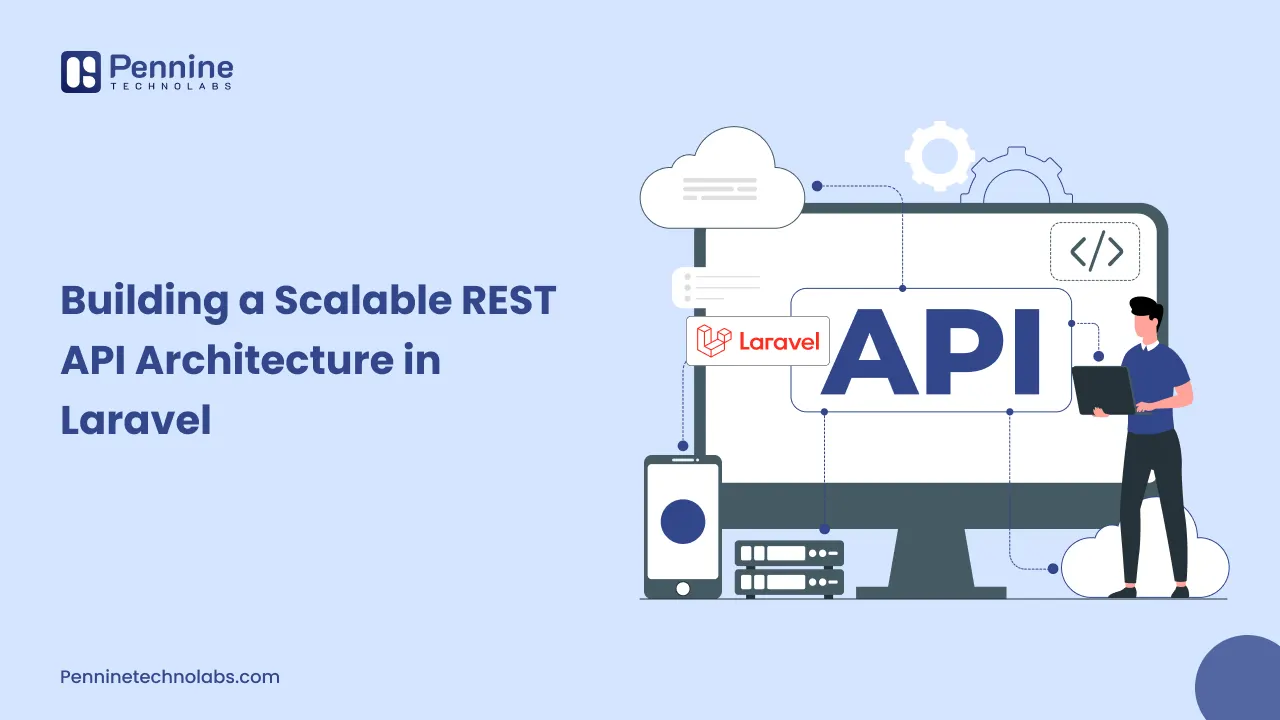
Quick Summary: This blog goes over the design of a scalable REST API with Laravel. We look at clean project structure, security, performance optimization, and also deployment, which supports the growth of modern apps in the long term.
Today’s digital platforms use APIs for application, user, and service interconnectivity. As REST APIs that don’t scale are introduced, they become points of failure as traffic and data volume grow.
Laravel provides a developer-friendly and scalable platform with every aspect of the framework designed for growth. When the right architectural choices are made, Laravel development services will maintain their stability, security, and performance as business needs expand.
What Makes a REST API Scalable
Scalability isn’t just for high traffic. Also included in it are performance, reliability, and clarity as the system grows.
A scalable REST API typically demonstrates:
- Clear separation of responsibilities
- Consistent request and response behavior
- Efficient database interactions
- Strong security and access control
Laravel has a modular design, and it’s full of built-in tools.
API-First Architecture in Laravel
In a backend-first approach, which is at the core of API design, services are independent and reusable.
Key architectural practices include:
- Creating a project that is API-only, without a front-end.
- Designing endpoints before building features
- Viewing the API as a product rather than a byproduct.
This strategy increases maintainability, which, in turn, makes scaling easier over time.
Organizing Code for Long-Term Growth
Clean code is key to scalability.
Suggested practices:
- Keep controllers focused on request handling
- Place business logic in service or action classes.
- Organize code by domain or feature
- Avoid tightly coupled components
This structure also decreases tech debt and improves team collaboration.
Designing RESTful Routes
Routing is what determines how clients interact with your API.
Well-designed routes:
- Follow REST naming conventions
- Use predictable URL patterns
- Present resources clearly
- Avoid unnecessary complexity
Laravel’s routing, a framework feature, makes it easy to create clean, expressive API endpoints.
API Versioning Strategy
API versioning enables your application to grow without breaking present integrations.
Effective versioning includes:
- Prefixing routes with version identifiers
- Maintaining separate controllers for each version
- Gradually deprecating older versions
Versioning is key to enterprise applications and long-term API stability.
Authentication Using Laravel Sanctum
Authentication protects APIs from unauthorized access.
Laravel Sanctum provides:
- Token-based authentication
- Secure access for SPAs
- Lightweight performance impact
- Easy middleware integration
It works for the majority of API based apps.
Keeping Controllers Lightweight
Controllers should remain focused and straightforward.
Best practices include:
- Delegating business logic to services
- Using request validation classes
- Applying single-responsibility principles
Lightweight controllers improve testability and scalability.
Standardizing API Responses
Consistency in responses improves client-side integration.
Laravel API Resources help:
- Control JSON response structure
- Prevent sensitive data exposure
- Improve clarity for API consumers
- Support future changes safely
Standardized responses enhance reliability and trust.
Performance Optimization Techniques
Performance is at the core of scalability.
Key optimization methods include: Key players in the field are:.
- Using deferred loading to eliminate redundant queries.
- Caching frequently accessed data
- Offloading heavy tasks to background jobs
- Applying rate limiting to control traffic
These practices provide for quick response times under load.
Key Features of Laravel for Scalable APIs.
Before putting in place advanced optimization strategies, it is essential to first know the core framework features which support scalability. These framework elements help to handle performance, security, and traffic as application demand grows.
| Feature | Role in API Design | Scalability Impact |
|---|---|---|
| API Resources | Response formatting | Consistent outputs |
| Sanctum | Authentication | Secure access |
| Eager Loading | Query optimization | Faster responses |
| Queues | Background processing | Reduced latency |
| Caching | Data reuse | Lower server load |
| Rate Limiting | Traffic control | Abuse prevention |
Background Jobs and Queues
Queues help APIs stay responsive.
Common queue use cases:
- Email delivery
- File processing
- Third-party API calls
- Report generation
Laravel queues improve response time in high traffic.
Error and Exception Handling
Proper error management improves developer and user experience.
Best practices include:
- Custom exception classes
- Clear error messages
- Proper HTTP status codes
- Centralized exception handling
This ensures predictable API behavior.
Deployment and Infrastructure
Scalable APIs require scalable infrastructure.
Laravel includes:.
- Managed hosting solutions
- Container-based deployments
- Horizontal scaling
- Performance acceleration tools
Infrastructure design is as important as code quality.
Why Use a Laravel Development Company?
A professional Laravel development firm brings architectural expertise and industry experience to the table. Teams know how to design APIs which scale well while also achieving business goals.
Leveraging Professional Laravel Development Services
Businesses tend to use Laravel development services for fast development. Also, these services improve code quality as systems scale up.
Outsourcing for a Laravel Developer Model.
Many businesses use an outsourced developer model to stay flexible. With a Laravel Developer For Hire, teams can add or reduce development support based on project workload, without long-term hiring commitments.
When to Hire Developer Teams
To speed up the development of complex APIs, companies turn to Laravel Developer teams with a proven track record. We see this for its efficiency and consistency.
API Solutions
A Laravel-based web development company that provides full-scale API solutions. These partners handle architecture, development, testing and optimization.
Scaling Laravel Website
Laravel for Business, which many companies are turning to to scale their user bases. These are ways to improve performance, and also to ensure long-term maintainability.
Support Growth
A reliable Laravel Development Agency that has technical implementation in sync with business goals. We thus achieve scalable APIs that support growth.
Performance Optimization
Effective in Clean Architecture, Automation and Performance Optimization is what we see in the field of Laravel Web Development. These practices also reduce future rework.
Strong Communication
Companies that need Laravel Development In USA often combine local oversight with an offshore delivery team. This setup supports strong communication and consistent quality, while also helping control development costs.
Sustainable Growth
Global companies often look beyond local hiring to build scalable and cost-efficient engineering teams. Choosing to Hire Laravel Developer In India allows businesses to access experienced professionals while maintaining budget control. This approach supports faster delivery without compromising on technical standards.
Laravel Development Process
A Laravel website typically operates with mature development processes, strong quality checks, and exposure to international projects. These teams are well-versed in handling complex APIs, long-term maintenance, and evolving application requirements for global clients.
Building Long-Term Capability
Organizations that Hire Laravel Developer from India for gain stable resources who grow alongside the product. This model supports long-term scalability, smoother knowledge transfer, and reliable technical ownership as applications expand.
Addressing API Scalability Challenges
Pennine Technolabs works to solve business API scalability issues, which include performance bottlenecks, rigid architecture, and security risks. We see to it that with the help of Laravel best practices, we put forth APIs which are robust, scalable and future-ready.
Conclusion
Building a scalable REST API in Laravel demands thoughtful planning, a well-structured architecture, consistent performance optimization, and a reliable deployment strategy. When these elements are aligned from the start, Laravel enables APIs to remain secure, maintainable, and responsive as usage grows. Pennine Technolabs carefully designs the Laravel API, which not only supports current application needs but also provides the flexibility required to adapt to future business expansion and evolving technical demands.