Quick Summary: Laravel has become the preferred framework for enterprises that need secure, scalable, and future ready web applications. Its clean architecture, built in tools, and powerful ecosystem help businesses turn complex requirements into stable digital products. This guide walks you through the complete enterprise Laravel development process so you understand how large scale applications are planned, built, tested, and deployed for long term success.
Laravel has become one of the most trusted PHP frameworks for building secure, scalable, and high-performing enterprise applications. Whether the goal is to simplify operations, modernize legacy systems, or create a feature-packed web application from scratch, Laravel still provides the structure and flexibility required for long-term growth.
The companies are using Laravel as their first choice due to it being capable of supporting enterprise-grade architecture, strong security, and rapid development cycles.
Choosing the right technology stack and development approach plays a major role in an organization’s long-term success. For many enterprises, Laravel development has become a dependable option for building secure, scalable, and feature-rich web applications.
Its clean architecture, built-in tools, and strong ecosystem make it suitable for projects of all sizes. With the right development team, businesses can use Laravel to bring complex ideas to life and deliver reliable digital products.
By going through this step-by-step guide, you will understand how enterprise Laravel development is conducted and why it is the most popular choice of global brands.
Step 1: Define the Application Goals and Business Requirements
Successful enterprise web applications start with clear objectives, ensuring every feature aligns with the organization’s priorities.
The web development team goes through the process of grasping what the business really wants to achieve before doing any of the programming work. This results in the identification of the target users, the workflows the application must support, as well as the long-term results that the system should bring.
Working with a professional PHP Laravel Development Company will definitely benefit you as they do a deep-dive requirements analysis by conducting workshops, interviews, and documentation review. This stage is quite an important one since it allows firm goals like increased productivity, better customer experience, automation, or even faster decision-making to be achieved through the final product.
Step 2: Choose the Right Technology Stack and Architecture
Laravel is flexible and works seamlessly with modern front-end frameworks, cloud platforms, and enterprise-level APIs without any issues.
The company decides on the architecture of the application: monolithic, microservices, or modular. No matter which architecture a company chooses, Laravel will be able to handle it and can still be scalable in various distributed environments.
Enterprises often depend on full-stack teams to manage complex projects. They may hire Laravel developers in India, engage senior architects in the USA, or work with managers who handle hybrid teams in regions like the UK or Australia. Making the right tech stack decisions early helps reduce technical debt and ensures long-term scalability.
Step 3: Build the Application Structure and Database Design
Once all planning is complete, the task is passed to the developers to create the basic structure. By using Laravel’s built-in features such as routing, middleware, Eloquent ORM, and MVC architecture, developers can handle code organization at an enterprise level more easily.
The database design has to be the main focus at this point. An enterprise system will heavily rely on strong data integrity and the ability to perform fast operations. Laravel offers migrations, seeders, and a schema builder that ease database version control and minimize the risk with large-scale updates.
This ensures that the database can always retain its scalability, be secure, and be optimized for future extensions when you decide to collaborate with a proficient Laravel Application Development Company.
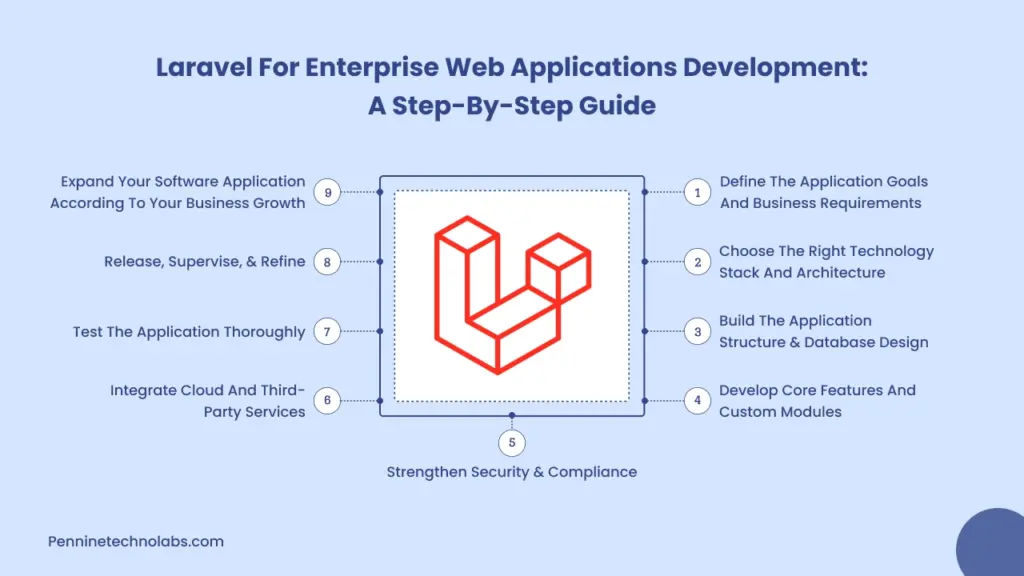
Step 4: Develop Core Features and Custom Modules
Once the frame is set, the web developers start working on the main features. Laravel suits the best for enterprise-level customization as it can be easily merged with:
- ERP systems
- CRM platforms
- Third-party APIs
- Payment gateways
- Cloud services
This step involves writing APIs, building dashboards, creating workflows, and, if necessary, developing custom modules based on the organization’s requirements. Enterprises often hire Laravel developers from India to expand their teams, as they offer strong technical expertise at a better cost.
Step 5: Strengthen Security and Compliance
Security is the main advantage of Laravel. Large datasets, user information, payment details, and confidential workflows are frequently the kinds of data enterprises are handling. To cope with such data, Laravel offers some built-in security instruments, e.g., CSRF protection, encryption, hashed passwords, and authorization gates.
Laravel websites guarantee that the application complies with industry standards of data protection, such as GDPR, SOC2, PCI-DSS, and HIPAA, depending on the place and the type of the project.
Step 6: Integrate Cloud and Third-Party Services
Any up-to-date enterprise application has to be compatible with cloud platforms such as AWS, Google Cloud, or Azure. Laravel doesn’t cause any problems when integrated with these platforms. The developers can also allow the app to do more with some third-party tools, such as:
- Analytics and monitoring
- Email and SMS services
- Inventory and accounting systems
- Authentication and SSO services
Laravel Website Development Services can ensure these integrations and migration to Laravel web apps take place seamlessly and without any application slowdowns.
Step 7: Test the Application Thoroughly
Web applications must be very reliable and without any bugs. Laravel allows the automation of different testing procedures, such as unit testing, feature testing, and browser testing, that can be done using Dusk. Apart from that, the QA teams get to use performance tests, load tests, and security tests to check the app before the release.
The testing stage is taken care of with great accuracy. The thorough testing stage stops future breakdowns, improves the user experience, and lowers the maintenance costs.
Step 8: Release, Supervise, and Refine
After the application has gone through the testing phase successfully, it is put in production (released). Laravel supports CI/CD pipelines, which is the reason why updates and releases are more user-friendly. Continuous monitoring is a process that the application is subjected to after the rollout in order to keep track of its performance, security, and stability.
Most businesses choose to keep a long-term relationship with a web app development agency for perpetual system upgrades, feature enhancements, and bug fixes. Hence, the eventual software evolution that matches the business progression becomes inevitable.
Step 9: Expand Your Software Application According to Your Business Growth
Laravel, being the major source of one’s business growth, has a great feature of scaling it up. The enterprise can be willing to support millions of users or can simply grow globally across the USA and globally. The Laravel framework allows for both horizontal and vertical scaling.
Companies often bring in additional developers to manage growing infrastructure needs and ensure the application continues to perform well as demand increases.
Conclusion
Laravel stands out as one of the best frameworks for enterprise web applications because it’s secure, scalable, and developer-friendly. Many global businesses choose Laravel to build robust, long-term solutions that stay stable even as their needs grow.
Pennine Technolabs Laravel developers offer a dedicated service provider or remote contractors, so you can turn your ideas into reality. Whether you’re updating legacy software or launching a new product, the right team helps you move from concept to deployment efficiently, accurately, and with long-term scalability in mind.
FAQs on Laravel Web Application
Is Laravel suitable for enterprise web applications?
Yes. Laravel offers scalability, security, and maintainability features that make it suitable for enterprise-grade web applications.
Can Laravel handle high traffic applications?
Yes. With proper architecture, caching, and queue management, Laravel can handle high traffic and large scale applications.
Is Laravel secure enough for enterprise projects?
Yes. Laravel includes built in security features such as authentication, encryption, and protection against common vulnerabilities.
Why do enterprises choose Laravel Web Development?
Enterprises choose Laravel for its clean architecture, rapid development capabilities, strong community support, and long term maintainability.